

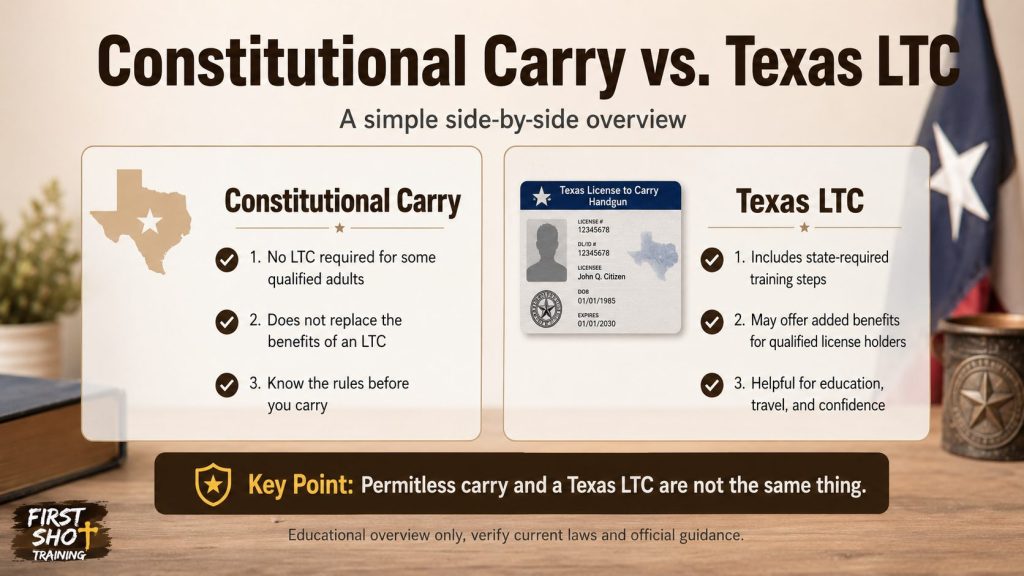
Constitutional carry versus LTC is a wording question more than a legal one. Constitutional carry is the phrase people use for permitless carry. An LTC is the Texas License to Carry, issued through the state handgun licensing process.
Quick answer: Constitutional carry means carrying without a license under certain conditions. A Texas LTC is a license issued after training, an application, fingerprints, and approval through Texas DPS. They are related, but not the same. This page is about the words. For the side by side comparison of carrying with and without a license, see Texas permitless carry versus a Texas LTC.
What Does Constitutional Carry Mean?
In everyday talk, constitutional carry means carrying a handgun without first getting a government issued carry license. People describe Texas that way because Texas allows certain people to carry a handgun without an LTC in some circumstances.
The phrase misleads people, because it is not a shortcut around every rule. Age, prohibited person status, restricted places, private property notices, and federal law all still apply. Verify current requirements through official sources.
What Is a Texas LTC?
A Texas License to Carry is a state issued handgun license run by Texas DPS. The process is a set path: classroom education, handgun proficiency, a state application, fingerprinting, and supporting documents. An LTC does not remove every rule or answer every legal question.
Why the Difference Matters
The difference matters because permitless carry is not training. It is a legal status that applies only when a person meets the requirements. An LTC class teaches safety, storage, dispute avoidance, and legal awareness before you move forward.
When you are ready to move from research to action, First Shot Training can help you begin online.
Why Some Texans Still Choose an LTC
Many Texans still choose an LTC for the formal education, the state issued credential, and possible reciprocity benefits when traveling. Others choose it because they are new to firearms and want a responsible starting point.
Frequently Asked Questions
Is constitutional carry the same as a Texas LTC?
No. Constitutional carry is commonly used to describe permitless carry. A Texas LTC is a state issued License to Carry with a defined training and application process.
Does constitutional carry mean there are no rules?
No. Carry rules can still involve age, eligibility, restricted places, private property notices, and federal law. Readers should verify current information through official sources.
Why would someone get an LTC if Texas has permitless carry?
Many Texans choose an LTC for structured education, documentation, possible travel benefits, and a better understanding of responsibilities.
Can First Shot Training tell me whether permitless carry applies to me?
No. First Shot Training provides educational information only. Personal legal questions should be directed to a qualified attorney.

Disclaimer: The information provided in this article is for general educational and informational purposes only and should not be considered legal advice. First Shot Training is not a law firm and does not provide legal advice. While we make every reasonable effort to ensure the information we publish is accurate and up to date at the time of publication, laws, regulations, licensing requirements, reciprocity agreements, and government policies may change without notice. You are responsible for verifying current information with official government sources before relying on any information contained in this article. If you have questions regarding how the law applies to your specific circumstances, consult a qualified attorney licensed in your jurisdiction.