
One of the most common questions about a Texas License to Carry has nothing to do with carrying. It comes up at the gun counter. Does the license let you skip the background check when you buy a firearm from a dealer?
The short answer is yes, in a specific and well-defined way, and there are limits that matter.
Before we go further, one distinction has to be clear, because these two things get blurred constantly.
This page is about the check a licensed dealer does not have to run on you at the point of sale, because you hold the license. That is a federal rule about the purchase.
It is not about the background check DPS runs on you while it decides your application. That one is part of getting licensed in the first place, and it is covered at does a Texas LTC require a background check.
Two different checks. Two different moments. Two different agencies. Keep them separate as you read.
This page is general education, not legal advice.
Table of Contents
Why These Two Checks Get Confused
The confusion is understandable. Both involve the words "background check" and both involve firearms, so people mash them together.
Here is the clean version.
When you apply for a Texas LTC, the state runs a check on you as part of deciding whether to issue the license. That process includes fingerprints, which is why fingerprints are part of the Texas LTC process. That check happens once per application cycle, and it is about eligibility for the license.
When you buy a firearm from a federally licensed dealer, the dealer normally contacts the National Instant Criminal Background Check System, known as NICS, before transferring the firearm. That check happens every time you buy, and it is about that transaction.
The exemption on this page is about the second one. Because you already went through the first one, federal law lets your license stand in for the second.
Quick Answer: Yes, and Here Is Exactly How Far It Goes
A valid Texas License to Carry qualifies as an alternative to the NICS check when you purchase a firearm from a federally licensed dealer.
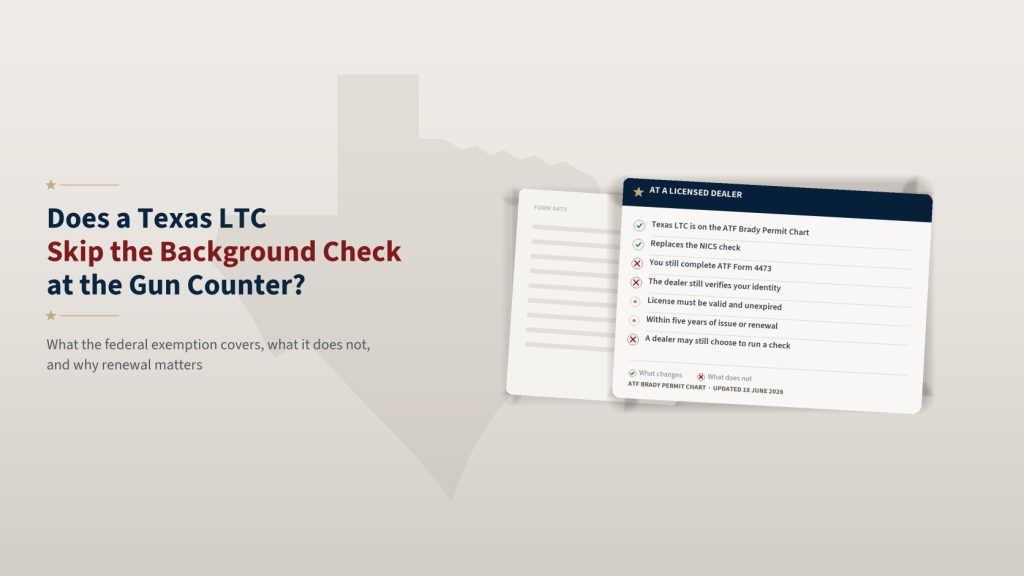
- ATF's Brady Permit Chart lists Texas, License to Carry, as Yes. It is treated as a qualifying alternative to a NICS check. The chart was last updated 18 June 2026. You can read it directly at the ATF Brady Permit Chart.
- It replaces the NICS check only. You still complete ATF Form 4473, and the dealer still verifies your identity.
- It applies to transfers from a federally licensed dealer.
- Your license has to be valid and unexpired. A lapsed license loses this benefit immediately.
- Five years is the outer limit. A permit valid for longer than five years qualifies only so long as no more than five years have elapsed since it was issued or renewed.
- A dealer may still choose to run a check anyway. That is their call, not yours.
- Every federal and state prohibition on firearm possession still applies. This is about the check, not about who may lawfully own a firearm.
Each of those is unpacked below.
What the ATF Chart Is and Why It Matters
ATF publishes a document commonly called the Brady Permit Chart. It lists, state by state, which state-issued permits qualify as an alternative to a NICS check under federal law, which do not, and which qualify only under certain conditions.
Texas appears on that chart with the License to Carry listed as a qualifying permit. The chart's most recent update is dated 18 June 2026.
This is the authoritative reference dealers use. If you ever want to check the current status yourself rather than take anyone's word for it, the chart is public and it is the right place to look. Rules change, and a chart with a date on it beats a forum post every time.
The 2025 ATF Open Letter
In May 2025, ATF issued an open letter to federal firearms licensees, numbered 2025L-01, which updated the Brady Permit Chart.
That update brought the qualifying list to roughly 28 states plus Puerto Rico. It is worth knowing that letter exists for two reasons.
First, it is a reminder that this list is maintained and revised. It is not frozen.
Second, it is a reminder that these determinations come from ATF, not from Texas. Texas issues the license. ATF determines whether that license satisfies the federal alternative-to-NICS standard. Both pieces have to line up.
The Five-Year Rule, and Why It Ties Directly to Renewal
This is the limit most license holders have never heard, and it is the one most likely to surprise someone at a counter.
ATF clarified that a permit valid for longer than five years still qualifies as an alternative to NICS only so long as no more than five years have elapsed since the date the permit was issued or renewed.
Read that carefully. It is not simply "is your license still valid." It is a question about how long it has been since the license was issued or last renewed.
The practical takeaway is straightforward. Keeping your license current is not just about staying licensed. It also keeps this particular benefit intact. The renewal process, and what it involves, is covered at Texas LTC renewal.
If you are not sure when yours was issued or last renewed, look. It takes a minute and it removes a surprise.
What Does Not Change: Form 4473 and Your ID
This is where people get caught off guard, so we will be blunt about it.
The exemption replaces the NICS check. It does not replace the paperwork.
You still complete ATF Form 4473, the firearms transaction record, in full and truthfully. Every question on it still applies to you. The dealer still verifies your identity. The dealer still keeps the required records.
Nobody walks in, shows a license, and walks out with no process. What actually changes is one step in the middle: the dealer does not have to contact NICS and wait on a response for that transfer.
Say that out loud before your next purchase and you will not be surprised at the counter.
It Applies at a Licensed Dealer
The exemption is about transfers from a federally licensed dealer. That is the context where a NICS check would otherwise be required, so it is the context where an alternative to that check is meaningful.
Nothing on this page changes any other rule about acquiring, possessing, transporting, or transferring a firearm under federal or Texas law. Those rules stand on their own, and they are worth knowing well.
Your License Has to Be Valid
A valid, unexpired license is the whole basis for the exemption. If the license has lapsed, the benefit is gone. Not delayed, not partially available. Gone, at that moment.
That is a small, concrete reason to stay on top of renewal instead of letting it slide. There are bigger reasons, but this one shows up in a very ordinary way: you go to buy something, hand over an expired card, and the transaction goes back to the standard process.
A Dealer Can Still Run a Check If They Want To
Here is something worth setting expectations about. Federal law permits the dealer to accept a qualifying permit in place of a NICS check. It does not require the dealer to do so.
Some shops run a check on every transfer as a matter of policy, regardless of what a customer holds. That is their prerogative, and it is not a slight against you or your license.
If it happens, the right response is to shrug and complete the transaction. Arguing at the counter about a policy the shop is entitled to have is not a good use of anyone's afternoon.
The Exemption Is About the Check, Not About Eligibility
This point matters more than any other on this page.
All federal and state prohibitions on firearm possession continue to apply. The exemption does not create any right to acquire or possess a firearm that a person would not otherwise have. It changes one procedural step for people who are already lawfully purchasing.
Anyone who is prohibited from possessing a firearm is still prohibited. Holding a license does not alter that, and the Form 4473 questions still ask what they ask, under penalty of law.
Frame it correctly in your own head: this is not a way around scrutiny. It is a recognition that the scrutiny already happened.
Why Federal Law Recognizes the Texas License
That last sentence is really the whole logic of the rule.
To get a Texas License to Carry, an applicant goes through a state process that includes a fingerprint-based background check, submits an application to DPS under the eligibility standards in the statute, and completes the required training and qualification. The license is governed by Texas Government Code Chapter 411, Subchapter H.
Federal law recognizes that a person who cleared that process has already been vetted in a substantive way. So rather than repeating a NICS inquiry on every purchase, the license itself can serve as the qualifying alternative, subject to the five-year limit described above.
That is the honest framing, and it is a good one. It is not a loophole. It is a state process being given credit by a federal rule.
Where This Fits in the "Is the License Even Worth It" Question
Since Texas adopted permitless carry, a lot of people have asked a reasonable question: if I can carry without it, why bother getting the license?
This exemption is one of the concrete answers. It is tangible, it applies every time you buy from a dealer, and it does not depend on interpretation.
It sits alongside a couple of other real benefits.
- Campus carry. The license matters on Texas college and university campuses. That subject has its own rules and its own page at Texas campus carry and the LTC.
- Recognition in other states. A Texas license is honored in a number of other states, which is what makes travel planning possible. See what states honor a Texas License to Carry.
We are only mentioning those here so you can see the full picture. Each one has its own page because each one deserves more than a sentence.
If you are weighing the license against permitless carry generally, that comparison is laid out at Texas permitless carry versus the LTC, and the broader value question is covered at is a Texas LTC still worth it.
What This Looks Like at the Counter
Put it all together and here is the realistic sequence when you buy from a dealer while holding a valid, current Texas LTC.
- You pick out the firearm and tell the dealer you hold a Texas License to Carry.
- You present the license along with your identification. The dealer verifies your identity and examines the license.
- You complete ATF Form 4473 in full, truthfully, the same as anyone else.
- The dealer, if they accept the permit as the qualifying alternative, does not contact NICS for that transfer.
- The dealer completes their records and the transfer proceeds under their normal procedure.
The realistic difference in your day is a shorter wait at one step. That is genuinely useful, and it is also not magic. Expecting exactly that is how you avoid frustration.
Keeping the Benefit
The upkeep is simple, and it comes down to two habits.
Know your dates. Know when your license was issued or last renewed, and know when it expires. Both of those matter here, because of the five-year rule and because of the plain requirement that the license be valid.
Renew before you lapse. Do not let it run out and plan to deal with it later. When it lapses, this benefit stops, along with everything else the license does for you.
If you have not gone through the process yet and you are trying to understand the whole path from class to card, the overview is at how to get a Texas LTC online.
The License to Carry is not a shortcut around responsibility. It is the opposite. It is proof that you took the long way on purpose: the training, the qualification, the fingerprints, the application, the wait. This exemption is one of the practical ways federal law acknowledges that. Understanding it accurately, limits included, is part of being the kind of license holder Texas is better off having.
Frequently Asked Questions
Does a Texas LTC replace the background check when buying a firearm?
A valid Texas License to Carry is listed on the ATF Brady Permit Chart as a qualifying alternative to the NICS check at a federally licensed dealer. It replaces the NICS check only. It does not remove any other step.
Do you still fill out Form 4473 with a Texas LTC?
Yes. The buyer still completes ATF Form 4473 and the dealer still verifies identity. Nothing about the paperwork or the identification requirement changes.
Does an expired Texas LTC still work for the purchase exemption?
No. The license must be valid and unexpired. ATF has also clarified that a permit qualifies only so long as no more than five years have elapsed since it was issued or renewed, which is one more reason to keep a licence current. See our Texas LTC renewal guide.
Can a dealer still run a background check on a Texas LTC holder?
Yes. The exemption permits a dealer to proceed without a NICS check, but an individual dealer may still choose to run one. That is their prerogative and it is not a sign that anything is wrong.
Does the exemption mean an LTC holder faces less scrutiny?
No. The exemption exists because the licensing process already included a fingerprint based background check. All federal and state prohibitions on firearm possession continue to apply. The exemption is about the check at the counter, not about who is eligible to possess a firearm.
Disclaimer: The information provided in this article is for general educational and informational purposes only and should not be considered legal advice. First Shot Training is not a law firm and does not provide legal advice. While we make every reasonable effort to ensure the information we publish is accurate and up to date at the time of publication, laws, regulations, licensing requirements, reciprocity agreements, and government policies may change without notice. You are responsible for verifying current information with official government sources before relying on any information contained in this article. If you have questions regarding how the law applies to your specific circumstances, consult a qualified attorney licensed in your jurisdiction.