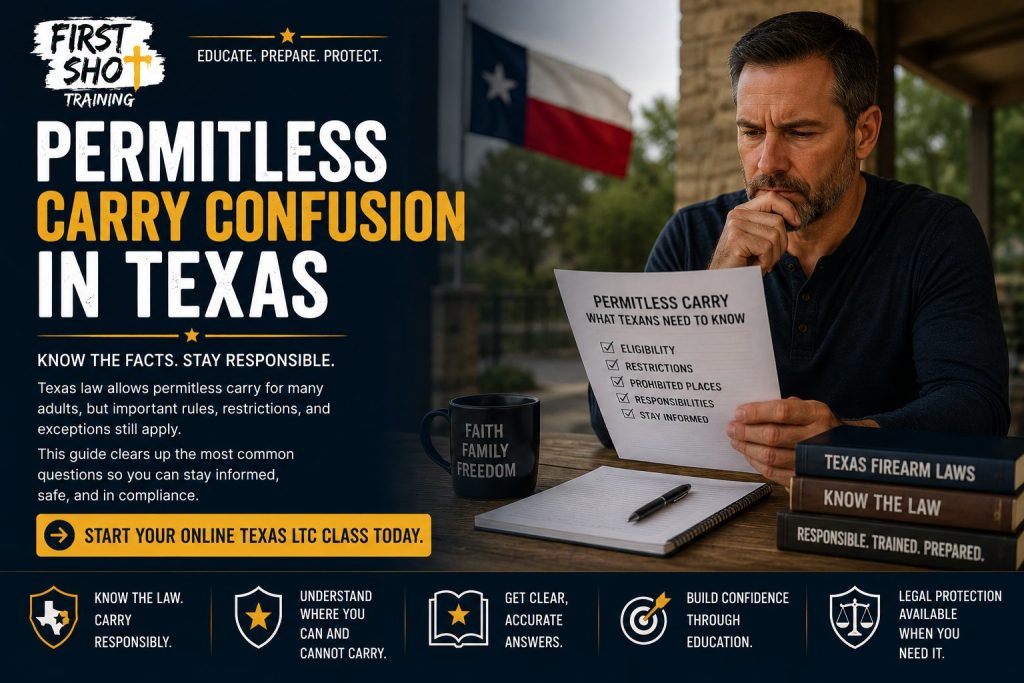
Confusion about permitless carry in Texas usually starts with one mistaken idea. People assume that if a license is not always required, the rules must be simple. Carry questions can still involve age, eligibility, location, private property, travel, and federal law.
Quick answer: Permitless carry creates confusion when people assume it applies to every person, every place, and every situation. It does not. A formal LTC class gives Texans an organized way to learn where the limits are.
Who Is Allowed to Carry
Not everyone may legally own or carry a firearm. Eligibility depends on the person and on facts that are specific to that person. First Shot Training cannot decide whether someone qualifies. It can help students understand what to look at and why it matters. Start with what to review about Texas LTC eligibility before you begin.
Age Rules for Carrying
Age rules cause a lot of mix-ups. Texas rules and federal rules are not the same. Short summaries online often leave out when they were written. Verify the current Texas and federal requirements on official sources before you rely on anything you heard informally.
Places Where Carry Is Still Restricted
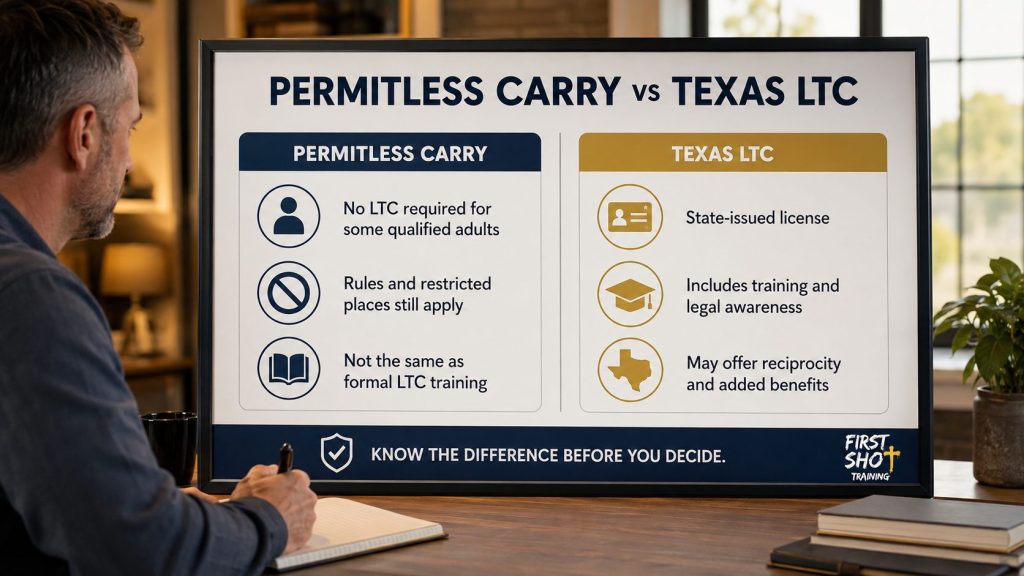
Some places are restricted whether or not a person holds an LTC. Other rules treat license holders and non license holders differently. Short lists of restricted places go out of date quickly.
Signs and Notices on Private Property
Private property signs and notices are one of the most common sources of confusion. Property owners have rights to restrict firearms on their own property. The kind of notice they post can matter.
Carrying Outside Texas
Texas permitless carry does not answer carry questions in other states. Travel may involve reciprocity, another state’s laws, and federal restrictions. This is one reason many Texans still value the LTC process.
Federal Law Still Applies
Federal law can apply even when the conversation is about state law. Schools, federal buildings, and airports are common examples. Those settings can involve rules that sit outside a basic Texas permitless carry discussion.
Continue learning, then start your Online Texas LTC Class when you are ready.
Why the LTC Class Helps Reduce Confusion
An LTC class gives students an organized way to learn the key terms, the responsible habits, and the next steps. It does not replace official sources or legal counsel. It builds a better foundation before serious decisions get made. Two of the areas above deserve their own reading. One is what carrying concealed without an LTC actually involves in Texas. The other is how the federal Gun Free School Zones Act interacts with a Texas LTC.
Frequently Asked Questions
Why is permitless carry confusing?
People talk about it as if it removed every rule. It did not. Eligibility, location, posted notice, travel, and federal law can all still matter.
Does permitless carry apply to every Texan?
No one should assume that. Whether a person may carry depends on that person, on their eligibility, and on their circumstances.
Can an LTC class answer every legal question?
No. It provides education, not legal advice. Personal legal questions should be directed to a qualified attorney.
Why should I take a class if I can find answers online?
A class puts the pieces in order. Searching one question at a time makes it easy to miss how the pieces fit together.
Disclaimer: The information provided in this article is for general educational and informational purposes only and should not be considered legal advice. First Shot Training is not a law firm and does not provide legal advice. While we make every reasonable effort to ensure the information we publish is accurate and up to date at the time of publication, laws, regulations, licensing requirements, reciprocity agreements, and government policies may change without notice. You are responsible for verifying current information with official government sources before relying on any information contained in this article. If you have questions regarding how the law applies to your specific circumstances, consult a qualified attorney licensed in your jurisdiction.