
Table of Contents
The Parking Lot Question
You leave the house in the morning with a handgun in the car. You drive to work. You pull into the lot your employer provides, and somewhere between the entrance and the front door a question shows up.
Is this allowed? And if the company handbook says no, does the handbook win?
It is one of the most common everyday firearms questions in Texas, and it comes up for people who are not looking for an argument. They just want to know the rule before they park.
Texas answers this question, and the answer is better than most people expect. It also sits in a place almost nobody thinks to look. This page walks through what the law says, where the limits are, and the one distinction that matters most. It is general education, not legal advice about your job or your circumstances. Only a Texas attorney can tell you how the law applies to your own situation.
Quick Answer: Yes, in a Locked Private Vehicle in the Employee Lot
Here is the short version.
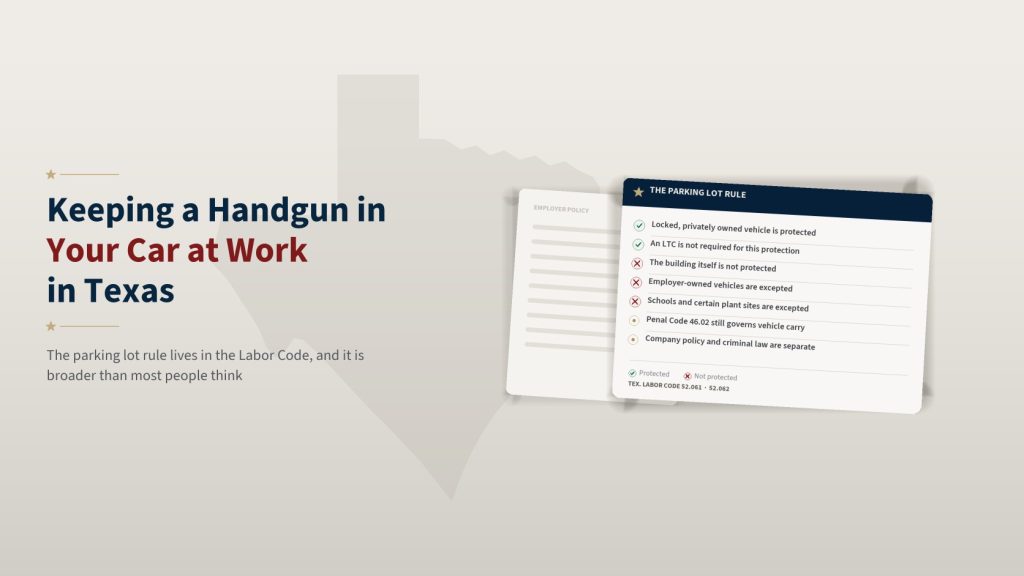
- Texas Labor Code Section 52.061 is the rule. A public or private employer generally may not prohibit an employee from transporting or storing a firearm or ammunition in a locked, privately owned motor vehicle in a parking lot, parking garage, or other parking area the employer provides for employees.
- You do not have to hold an LTC. The statute protects a license holder or a person who otherwise lawfully possesses the firearm. A lot of secondary sources get this wrong.
- The vehicle must be privately owned and locked. Both words are in the statute.
- The protection covers the parking area, not the building. Section 52.062(b) lets an employer still prohibit firearms on the premises of the business.
- There are real exceptions, including company vehicles, schools, certain mineral lease properties, and certain chemical and refining sites.
- Company policy and criminal law are two different things. Losing a job and committing an offense are not the same event.
That last point is where most of the practical trouble lives, and it gets a section of its own further down.
This Rule Lives in the Labor Code, Not the Penal Code
Before anything else, it helps to know why this question feels slippery.
Almost every Texas carry rule people know sits in the Penal Code. Where you may carry, how you may carry, what signage means, what is an offense. That is the body of law most articles about Texas firearms are working from.
The parking lot rule is not there. It is in the Labor Code, in Chapter 52, which governs the employment relationship. That placement tells you what kind of rule it is. It is not primarily about what you may do with a firearm. It is about what an employer may prohibit.
That distinction matters because it changes the shape of the answer. Texas did not write a rule saying "you may keep a handgun in your car at work." Texas wrote a rule limiting an employer's authority to forbid it. Those sound similar and they are not.
It also means this is a different question from the one people usually ask about businesses and firearms. A property owner deciding whether customers may carry inside a store is operating under a completely separate set of rules, which we cover in how Texas businesses restrict firearms on private property. That page is about the Penal Code, signage, and premises. This page is about your employer and your parking spot. Keep them separate and both get much clearer.
What Section 52.061 Actually Says
A lot of writing about this statute paraphrases it badly, so here it is in full:
A public or private employer may not prohibit an employee who holds a license to carry a handgun under Subchapter H, Chapter 411, Government Code, who otherwise lawfully possesses a firearm, or who lawfully possesses ammunition from transporting or storing a firearm or ammunition the employee is authorized by law to possess in a locked, privately owned motor vehicle in a parking lot, parking garage, or other parking area the employer provides for employees.
Read it slowly, because every clause is doing work.
"A public or private employer." Both. Government employers and private companies are covered by the same rule.
"May not prohibit." This is a restriction on the employer, not a grant of authority to you.
"Locked." The vehicle has to be locked.
"Privately owned motor vehicle." Your vehicle, not the company's. That distinction comes back in the exceptions.
"A parking lot, parking garage, or other parking area the employer provides for employees." The protection is tied to the employee parking area specifically.
"The employee is authorized by law to possess." The statute never protects possession that is unlawful in the first place.
You Do Not Need an LTC for This Protection
This is the single most misreported point about Section 52.061, and it is worth being precise about.
Look again at who the statute covers. It names three categories, joined by "or":
- An employee who holds a license to carry a handgun under Subchapter H, Chapter 411, Government Code
- An employee who otherwise lawfully possesses a firearm
- An employee who lawfully possesses ammunition
That second category is the one people miss. The protection is not limited to license holders. It extends to an employee who otherwise lawfully possesses the firearm.
You will find articles and even some HR materials stating that you must hold a Texas LTC for the parking lot law to protect you. That is contradicted by the statute's own words. The Legislature wrote "or who otherwise lawfully possesses a firearm" on purpose, and that phrase is not decoration.
What the statute does require is that the possession be lawful. The protection follows lawful possession, whether that possession rests on a license or on Texas law generally. If a person may not lawfully possess a firearm at all, no part of this statute helps them, and we cover that further down.
If you are weighing whether to get licensed for other reasons, the parking lot rule should not be the deciding factor either way. Our page on permitless carry compared with an LTC lays out what the license actually adds, and whether a Texas LTC is still worth it takes on the broader question honestly.
The Parking Area Is Protected. The Building Generally Is Not.
Here is the practical line, and it is a bright one.
Texas Labor Code Section 52.062(b) provides that an employer may still prohibit employees from possessing a firearm on the premises of the employer's business, using the definition of "premises" from Penal Code Section 46.03.
So Section 52.061 protects the locked private vehicle in the employee parking area. Section 52.062(b) preserves the employer's authority over the building itself.
That pairing is the whole design. The Legislature drew a line at the car door. Your employer generally may not reach into your locked private vehicle in the lot it provides you. Your employer may still say that firearms do not come inside the workplace.
For the great majority of employees, that is the entire answer to the question they were asking. The handgun stays in the locked car. You go into the building. Nobody has a problem.
The Exceptions in Section 52.062
Section 52.062 also sets out situations where the parking lot protection does not apply at all. These are specific, and if one of them describes your workplace it changes your answer completely.
First, the general limit: Section 52.061 does not authorize possession where it is otherwise prohibited by law. The statute never overrides another law. It only limits employers, so the statewide rules on where you cannot carry a handgun in Texas still apply on top of it.
Then the four listed exceptions.
1. Employer-owned or leased vehicles used for work. The protection does not apply to a vehicle owned or leased by a public or private employer and used by the employee in the course of employment, unless the employee is required to transport a firearm as part of their duties.
2. Schools. The protection does not apply to school districts, open-enrollment charter schools, or private schools. Schools carry their own layers of state and federal rules, and our page on the federal Gun-Free School Zones Act and a Texas LTC covers part of that picture. College and university employees are a separate case again, governed by the campus statute we cover in Texas campus carry.
3. Certain mineral lease properties. The protection does not apply to property on which a valid, unexpired oil, gas, or other mineral lease contains a firearm prohibition.
4. Chemical manufacturers and oil and gas refiners. The protection does not apply to property owned or leased by a chemical manufacturer or oil and gas refiner handling hazardous materials. There is a limited exception within that exception: a licensed handgun holder may store a firearm in a locked private vehicle in a monitored employee parking area located outside a secured plant area.
Note that the fourth exception is the one place in this chapter where holding a license genuinely does change the outcome. Everywhere else, lawful possession is enough. At a covered chemical or refining site, the narrow carve-out is written for a licensed holder in a monitored lot outside the secured area.
If you work in energy, chemicals, or education in Texas, read Section 52.062 carefully. These are not hypothetical categories in this state. They describe a very large number of Texas workplaces.
Company Vehicles Deserve Their Own Paragraph
The company vehicle exception catches people, because the daily experience feels identical.
If you drive a truck or van your employer owns or leases, and you use it in the course of your employment, Section 52.061 does not protect you in that vehicle. The parking lot rule is built around a privately owned motor vehicle, and Section 52.062 says so directly.
The statute leaves one opening: unless the employee is required to transport a firearm as part of their duties. That is a narrow path, and it describes people whose job actually requires it, not people who would simply prefer to.
So if your commute happens in a company truck, the honest answer is that this statute is not doing anything for you, and your employer's policy governs. That is worth knowing before it comes up rather than after.
How the Handgun Is Carried in the Vehicle
Section 52.061 answers what your employer may prohibit. Texas Penal Code Section 46.02 answers how a handgun may lawfully be carried in a vehicle in the first place, and both have to work out.
Texas Penal Code Section 46.02(a-1) makes it an offense to carry a handgun in a motor vehicle or watercraft in plain view unless the person is 21 or older or licensed, and the handgun is in a holster.
There is more to the vehicle rule than plain view. Carrying a handgun in a vehicle also requires that the person is not engaged in criminal activity, is not a person prohibited under Section 46.04, and is not a member of a criminal street gang.
The current shape of Section 46.02 comes from House Bill 1927, passed by the 87th Legislature in 2021, Chapter 809, effective 1 September 2021. That is the permitless carry law, and it rewrote how vehicle carry works in Texas for a lot of people.
The plain practical reading for a working adult: a handgun in a vehicle belongs in a proper holster, and keeping it out of view is both the safer choice and the simpler one. Secured, holstered, and out of sight is the habit that keeps this uncomplicated.
If a routine traffic stop happens on the commute, knowing how that works in Texas ahead of time keeps it calm. Our page on being stopped while carrying in Texas covers what to expect.
If You May Not Lawfully Possess a Firearm
This has to be said clearly, because the parking lot statute is not a workaround.
Section 52.061 protects transporting or storing a firearm the employee is authorized by law to possess. If a person is prohibited from possessing a firearm, nothing in the Labor Code changes that.
Texas Penal Code Section 46.02(a-7) provides that a person prohibited from possessing a firearm under Section 46.04(a), (b), or (c) commits a second or third degree felony for carrying off their own premises or vehicle. That is what the law provides, stated plainly.
So the threshold question always comes first. Lawful possession is the foundation the entire parking lot protection is built on. If there is any question about where you stand, that is a conversation for a Texas attorney before it is a question about a parking space. Our page on what carrying concealed without an LTC looks like in Texas covers the general framework for who may carry under state law.
Company Policy and Criminal Law Are Not the Same Thing
This is the section most people actually need, and it is the one most articles leave out.
Section 52.061 limits what an employer may prohibit in the parking area. It is not a shield against every consequence at work.
Here is the distinction, as plainly as it can be put:
Criminal consequences come from the state. They involve law enforcement, charges, and courts. They arise when someone violates the Penal Code.
Employment consequences come from your employer. They involve HR, discipline, and the possibility of losing your job. They arise when someone violates company policy.
Those two systems run on separate tracks. Conduct can be perfectly lawful and still violate a workplace policy. Texas is an at-will employment state, and the reasons an employer may act on are broad.
What Section 52.061 gives you is a limit on what your employer may prohibit in a specific place: the locked, privately owned vehicle in the employee lot. What it does not give you is immunity from a policy governing conduct inside the building, or a guarantee about how any particular workplace dispute plays out.
The fair and honest framing is this: the statute settles a legal question, not a workplace one. If your employer has a policy that goes further than the statute allows in the parking area, that is a matter to raise carefully and, if it matters to you, with a Texas employment attorney. It is not something to test quietly on a Tuesday morning and find out the hard way.
Habits That Keep This Simple
Most people who ask this question want a routine they can stop thinking about. Here is what that looks like.
- Know your workplace category. If you work for a school, an energy or chemical site, or you drive a company vehicle, read Section 52.062 before you assume anything.
- Lock the vehicle. The statute says locked. It is not a technicality, it is the condition.
- Keep it out of sight and holstered. Secured, covered, and undisturbed. That is the safe practice and it keeps the vehicle rules simple.
- Read your employee handbook. Not to be alarmed by it, but so you know what it says about the building versus the lot.
- Do not bring it inside. Section 52.062(b) preserves your employer's authority over the premises. The building is not the fight this statute picked.
- Ask before you assume. If your situation is genuinely unclear, an hour with a Texas attorney costs far less than a job.
The Honest Summary
Can you keep a handgun in your car at work in Texas? For most employees, yes.
Texas Labor Code Section 52.061 says a public or private employer may not prohibit an employee from transporting or storing a firearm or ammunition in a locked, privately owned motor vehicle in a parking area the employer provides. It protects license holders and people who otherwise lawfully possess a firearm, whatever you may have read elsewhere.
The limits are real and they are specific. The building is not covered. Company vehicles are not covered. Schools, certain mineral lease properties, and certain chemical and refining sites are carved out. Lawful possession is the foundation for all of it. And a policy violation can still cost you a job even where no offense has occurred.
None of that is hard to live with. Know which category your workplace falls into, keep the vehicle locked, keep the handgun secured and out of sight, and leave it in the car when you go inside. That is the whole routine, and for the great majority of working Texans it is the end of the question.
Frequently Asked Questions
Can a Texas employer ban guns in the employee parking lot?
Generally no. Texas Labor Code Section 52.061 provides that a public or private employer may not prohibit an employee from transporting or storing a firearm or ammunition in a locked, privately owned motor vehicle in a parking lot, parking garage or other parking area the employer provides for employees.
Do you need a Texas LTC for the parking lot law to protect you?
No. The statute protects an employee who holds a License to Carry, or who otherwise lawfully possesses a firearm, or who lawfully possesses ammunition. A number of secondary sources state this incorrectly. The protection is not limited to license holders.
Does the parking lot law cover the inside of the building?
No. Texas Labor Code Section 52.062(b) preserves an employer’s authority to prohibit firearms on the premises of the employer’s business, using the definition of premises from Penal Code Section 46.03. The parking area is protected. The building generally is not.
What are the exceptions to the Texas parking lot gun law?
Section 52.062 lists them. They include vehicles owned or leased by the employer and used in the course of employment, school districts and open-enrollment charter and private schools, property subject to an oil, gas or other mineral lease that prohibits firearms, and property operated by chemical manufacturers or refiners handling hazardous materials, with a limited carve-out for a locked private vehicle in a monitored employee lot outside the secured plant area.
Can you still be fired for keeping a gun in your car in Texas?
Employment consequences and criminal consequences are two different things. Section 52.061 limits what an employer may prohibit in the parking area, and it is not a guarantee about how any particular workplace dispute is resolved. Anyone facing a real dispute with an employer should talk to a Texas attorney.
Disclaimer: The information provided in this article is for general educational and informational purposes only and should not be considered legal advice. First Shot Training is not a law firm and does not provide legal advice. While we make every reasonable effort to ensure the information we publish is accurate and up to date at the time of publication, laws, regulations, licensing requirements, reciprocity agreements, and government policies may change without notice. You are responsible for verifying current information with official government sources before relying on any information contained in this article. If you have questions regarding how the law applies to your specific circumstances, consult a qualified attorney licensed in your jurisdiction.