Texas gives responsible adults a lot of freedom to carry a handgun. Texas also keeps a list of places where handguns are not allowed, no matter how careful or how well trained you are. Learning that list is a normal part of carrying responsibly, and it is one of the first things a good Texas License to Carry class teaches.
Table of Contents
Quick Answer: Where You Cannot Carry a Handgun in Texas
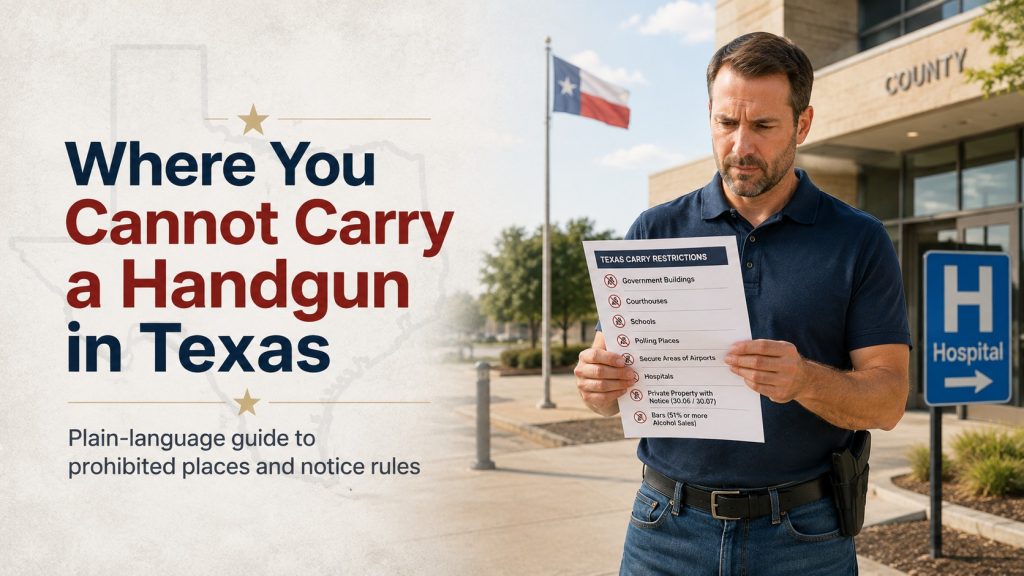
Texas Penal Code Section 46.03 lists the main places where firearms are off limits in Texas. The list includes schools, polling places on election days, government courts, racetracks, secured airport areas, bars that make most of their money from alcohol served on site, sporting events, correctional facilities, civil commitment facilities, hospitals and nursing facilities, mental hospitals, amusement parks, and rooms where an open government meeting is being held. A few of those places allow carry with written permission. Holding a Texas License to Carry does not, by itself, change most of these rules.
Texas Keeps Most Off Limits Places in One Law
For many years, Texas split these rules across more than one statute. One list applied to everyone, and a second list applied only to people who held a License to Carry. That made the law confusing to read, and it is part of why people still get this wrong.
Texas has since brought the main rules together in Section 46.03 of the Penal Code, titled Places Weapons Prohibited. The version in effect today was last amended by House Bill 1760 in 2023. It applies to firearms, and it also applies to location restricted knives, clubs, and the prohibited weapons listed in Section 46.05.
This matters for a simple reason. If you learned these rules years ago, some of what you remember may be filed under a section number that no longer works the way it used to. The places themselves are largely the same. The way the law is organized has changed.
The Places Texas Penal Code 46.03 Lists
Here is the list in plain language. The statute is the final word, and the exact wording matters, so the official text is linked at the bottom of this page.
- Schools and colleges. School property, school grounds and buildings where a school activity is happening, and school transportation vehicles. This covers public and private schools. There is an exception when the school or institution allows it in writing, and there is a separate rule for license holders on college campuses that is covered further down.
- Polling places. On the day of an election, or while early voting is in progress.
- Courts. Government courts, and offices used by the court, unless the court allows it in writing.
- Racetracks.
- Secured airport areas. This means past the security checkpoint, not the whole airport.
- Near a place of execution. Within 1,000 feet of a location designated by the Texas Department of Criminal Justice as a place of execution, on a day a death sentence is set to be carried out there, when you have been given notice.
- Bars that make most of their income from alcohol. Specifically, a business holding certain Alcoholic Beverage Code permits that gets 51 percent or more of its income from alcohol served for drinking on site, as determined by the Texas Alcoholic Beverage Commission.
- Sporting events. Anywhere a high school, college, or professional sporting event or interscholastic event is taking place. There is a narrow exception for a participant using the item in the event itself.
- Correctional facilities.
- Civil commitment facilities.
- Hospitals and nursing facilities. Licensed hospitals and licensed nursing facilities, unless you have written permission from the administration.
- Mental hospitals. Unless you have written permission from the administration.
- Amusement parks. The statute uses a narrow definition, described further down.
- Open government meetings. The room or rooms where a meeting of a governmental body is being held, when the meeting is open to the public and proper notice was given.
That is fourteen categories. Most people can carry responsibly for years and only ever bump into three or four of them. Reading the whole list once is still worth your time, because the ones people forget are usually the ones that cause trouble.
A Texas License to Carry Does Not Unlock These Places
This is the single biggest misunderstanding, so it deserves its own section.
Section 46.03 says plainly that holding a license to carry is generally not a defense to prosecution under that section. There is one narrow exception written into the statute, which involves a handgun found at an airport security screening checkpoint when the person leaves immediately.
So a License to Carry is not a key to the courthouse door. What a Texas LTC actually does is different, and still valuable. It gives you a recognized credential, it is honored by many other states, and it changes how some other Texas rules apply to you. If you are weighing whether the license is worth it, our article on whether a Texas LTC is still worth it after permitless carry walks through the honest reasons people still get one.
What a license does not do is move a place off this list.
What Premises Means, and Why Parking Areas Are Treated Differently
Section 46.03 defines premises as a building, or a portion of a building. The definition then says the term does not include a public or private driveway, street, sidewalk or walkway, parking lot, parking garage, or other parking area.
That definition does a lot of quiet work. When the statute says you cannot carry on the premises of a hospital, it is talking about the building. The hospital parking garage is not part of the premises under that definition.
Two cautions belong with that, and they are important.
First, this definition is specific to Section 46.03. Other laws, including federal law near schools and separate rules about signs, can still apply to the same piece of ground. Our article on the federal Gun Free School Zones Act covers one common example.
Second, a property owner can still ask you to leave, and there are separate Texas laws about posted notice. Those are covered next.
Bars, Restaurants, and the 51 Percent Rule
People ask about this one more than any other, usually because a family dinner is involved.
The statute does not say “any place that serves alcohol.” It says a business that holds certain Alcoholic Beverage Code permits and that gets 51 percent or more of its income from alcoholic beverages sold or served for drinking on the premises, as determined by the Texas Alcoholic Beverage Commission.
In everyday terms, that generally describes a bar rather than a restaurant that happens to have a bar area. Texas requires qualifying businesses to post a specific red sign with the number 51 on it. If you see that sign, the business falls in this category.
The practical habit is simple. Look at the door. Texas built a sign system precisely so that people do not have to guess, and reading signs on the way in is a small habit that prevents a large problem.
Hospitals, Nursing Facilities, and Mental Hospitals
Hospitals licensed under Chapter 241 of the Health and Safety Code, and nursing facilities licensed under Chapter 242, are on the list. So are mental hospitals as defined in Section 571.003.
For all three, the statute allows carry with written authorization from the facility administration. In real life that permission is uncommon, and it is not something you assume. If you are visiting a family member regularly and you want to know where you stand, ask the facility in advance rather than at the door.
Remember the premises definition here too. The prohibition attaches to the building, not to the parking garage.
Schools and College Campuses
School property is the strictest entry on the list, and it is worth separating the two kinds of schools.
For primary and secondary schools, the rule is broad. It covers the premises, it covers grounds and buildings where a school sponsored activity is happening, and it covers school transportation vehicles. Written regulations or written authorization from the school are the exception.
For colleges and universities, Texas law works differently. The statute carves out a specific allowance for a person carrying a concealed handgun under a Texas License to Carry, and no other weapon covered by the section, at a postsecondary educational institution. Other subsections then add limits. Open carry is not allowed on those campuses. A private or independent institution may prohibit carry entirely. Public institutions may establish rules about specific portions of campus.
This is one of the few places where holding a Texas License to Carry genuinely changes what the law allows, which is a good example of why the license still matters to a lot of Texans. It is also a good example of why campus rules need to be checked at the specific campus, because institutions are allowed to set some of their own boundaries, and we walk through those details in carrying a handgun on a Texas college campus.
Sporting Events, Amusement Parks, and Open Government Meetings
These three come up less often, and each has a detail people miss.
Sporting events. The statute covers the premises where a high school, collegiate, or professional sporting event or interscholastic event is taking place. Note that this is tied to the event, not only to the venue. A stadium hosting a professional game on Sunday afternoon is a different situation from the same building on a quiet Tuesday.
Amusement parks. The definition is narrow and specific. It describes a permanent indoor or outdoor facility with amusement rides open to the public, located in a county with more than one million people, covering at least 75 acres, enclosed with controlled entries, open more than 120 days a year, and with security guards on the premises at all times. A small local fair does not fit that definition. A large theme park in a major metro area may.
Open government meetings. This one applies to the room or rooms where a meeting of a governmental body is being held, when the meeting is open under the Texas Open Meetings Act and the entity gave the required notice. City council chambers during a council meeting is the everyday example.
Carrying While Intoxicated
This one is not a place, but it belongs in any honest discussion of when carrying is not allowed.
Texas Penal Code Section 46.02 makes it an offense to carry a handgun while intoxicated. There are exceptions written into the statute, including being on your own property or property under your control, being on private property with the owner’s consent, and being inside or directly on the way to a vehicle or watercraft you own or control, or one you have permission to use.
The responsible reading of that is straightforward. Alcohol and carrying do not mix well, and the safest habit is to decide before you leave the house which one the evening involves.
Private Property Signs Are a Separate Question
Everything above comes from Section 46.03. Private property owners have their own separate authority under Texas law, and they use a different set of statutes.
Those are the trespass provisions in Chapter 30, including the notice rules people know by their section numbers. We cover them in detail in our articles on Texas 30.05, 30.06, and 30.07 signs and on whether Texas businesses can restrict firearms on private property.
The short version is that a place can be perfectly legal under Section 46.03 and still be closed to carry because the owner has given proper notice. Both systems operate at the same time.
It is also worth knowing what to do if you are ever stopped while lawfully carrying, which we cover in what Texans should know if they are stopped while carrying.
Why the Texas LTC Class Covers Exactly This
If this list feels like a lot to hold in your head, that reaction is normal, and it points at something useful.
Texas DPS requires the License to Carry classroom course to cover four topics. The first one is laws that relate to weapons and to the use of deadly force. The others are handgun use and safety, nonviolent dispute resolution, and proper storage practices, with an emphasis on storage that prevents accidental injury to a child. DPS says the classroom instruction covers those four required topics and may run four to six hours.
In other words, the material on this page is not extra credit. It is the required curriculum, taught in order, with the reasoning behind it. That is a very different experience from reading a statute cold.
DPS also allows the classroom portion to be completed online through an approved online course provider. After you pass the online classroom portion, you still attend range instruction and demonstrate handgun proficiency with a Texas qualified LTC instructor. Our article on how the Online Texas LTC Class works from start to finish explains that sequence, and what the Texas LTC written test covers explains what the exam actually asks.
A last honest note. Laws change, courts interpret them, and the details of a specific situation matter. This page is general education about what Texas law currently lists, not legal advice about your circumstances. If you have a question about your own situation, a Texas attorney is the right person to ask. And if you carry regularly, it is worth rereading the current statute once a year, because the 2023 reorganization is a good reminder that these sections do move.
Official Texas Sources
- Texas Penal Code Chapter 46, Weapons, including Section 46.03 Places Weapons Prohibited and Section 46.02
- Texas Penal Code Chapter 30, Burglary and Criminal Trespass, including the posted notice provisions
- Texas Government Code Chapter 411, Subchapter H, License to Carry a Handgun
- Texas DPS, Training Requirements FAQ
Frequently Asked Questions
Can I carry in a restaurant that serves alcohol in Texas?
It depends on the business. Texas Penal Code Section 46.03 covers a business that holds certain Alcoholic Beverage Code permits and gets 51 percent or more of its income from alcoholic beverages served for drinking on site, as determined by the Texas Alcoholic Beverage Commission. In everyday terms that generally describes a bar rather than a restaurant that has a bar area. Qualifying businesses are required to post the red 51 percent sign, so reading the door on the way in is the reliable habit.
Does a Texas License to Carry let me carry in these places?
Generally no. Section 46.03 says that holding a license to carry is not a defense to prosecution under that section, apart from one narrow airport screening exception written into the statute. The main place a Texas license does change what the law allows is a college campus. Our article on u003ca href=u0022/is-texas-ltc-still-worth-it/u0022u003ewhether a Texas LTC is still worth itu003c/au003e covers what the license actually does for you.
Can I leave a handgun in my car in the parking lot of one of these places?
Section 46.03 defines premises as a building, or a portion of a building, and says the term does not include a public or private driveway, street, sidewalk or walkway, parking lot, parking garage, or other parking area. That definition applies to Section 46.03. Other laws and separate property rules can still apply to the same ground, so it is worth understanding the difference rather than assuming.
Do these rules change because Texas has permitless carry?
No. Permitless carry changed who may carry a handgun without a license. It did not remove the places listed in Section 46.03. Our article on u003ca href=u0022/permitless-carry-confusion-texas/u0022u003ewhere permitless carry creates confusion in Texasu003c/au003e walks through that difference.
Where does the Online Texas LTC Class fit into learning this?
Texas DPS requires the License to Carry classroom course to cover four topics, and the first one is laws that relate to weapons and to the use of deadly force. DPS allows that classroom portion to be completed online through an approved online course provider. After passing the online classroom portion you still attend range instruction and demonstrate handgun proficiency with a Texas qualified LTC instructor. See u003ca href=u0022/online-texas-ltc-class-how-it-works/u0022u003ehow the Online Texas LTC Class worksu003c/au003e for the full sequence.
Disclaimer: The information provided in this article is for general educational and informational purposes only and should not be considered legal advice. First Shot Training is not a law firm and does not provide legal advice. While we make every reasonable effort to ensure the information we publish is accurate and up to date at the time of publication, laws, regulations, licensing requirements, reciprocity agreements, and government policies may change without notice. You are responsible for verifying current information with official government sources before relying on any information contained in this article. If you have questions regarding how the law applies to your specific circumstances, consult a qualified attorney licensed in your jurisdiction.