
There is a large, quiet group of Texans who never apply for a License to Carry because of one belief. They think that seeing a counselor once, or carrying a diagnosis from the VA, or getting help during a hard stretch of life, means the state will never say yes. So they do not bother. They do not ask. They just assume.
That assumption is worth checking, because Texas law does not say what those folks think it says.
This page walks through what the License to Carry statute actually asks about mental health, what it does not ask, and what the law provides for people whose history includes a diagnosis. It is general education. It is not legal advice and it is not medical advice. Questions about your own health belong with your physician. Questions about your own application belong with a Texas attorney.
Table of Contents
The Belief That Keeps Good People From Applying
Ask around and you will hear versions of the same sentence. "I talked to somebody after my divorce, so I figured that was that." "I have a VA rating, so I never applied." "I was on medication for a while in my twenties. I assumed it was automatic."
None of those sentences describes a rule in the Texas statute. They describe a fear, and fears travel faster than statutes do.
Texas put its eligibility rules in writing. They are in Texas Government Code Section 411.172, and anyone can read them. That is the whole point of writing them down. The state is not asking whether you have ever struggled. It is asking a narrower question, and the difference is significant.
Quick Answer: Does a Mental Health History Disqualify You in Texas?
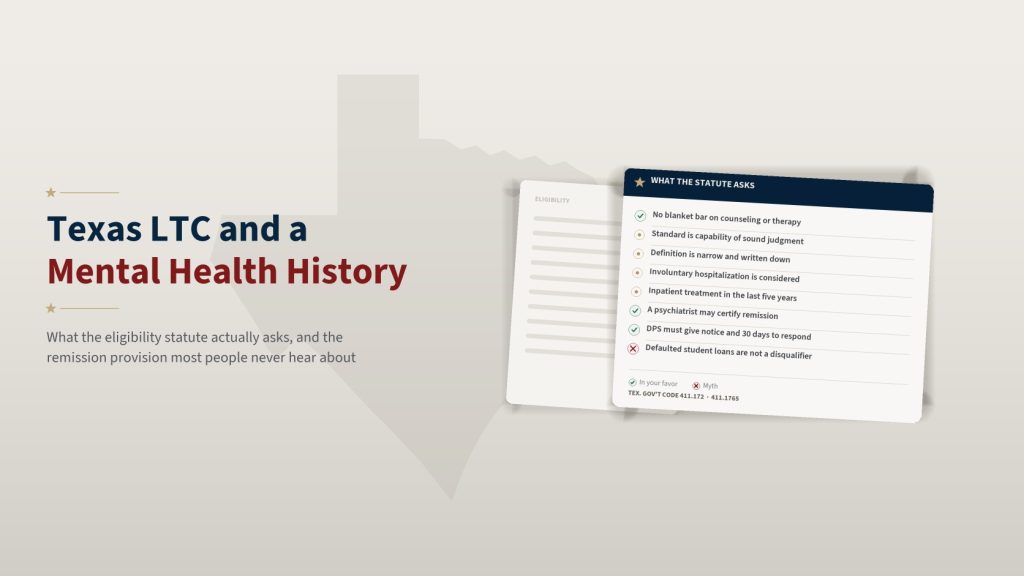
There is no blanket bar in Texas law on having sought counseling or therapy. Section 411.172 does not contain a rule that says a person who has seen a mental health professional cannot be licensed.
What the statute requires is that an applicant be "capable of exercising sound judgment with respect to the proper use and storage of a handgun." That language is in Section 411.172(a)(7).
The statute then defines, in Section 411.172(d), a specific and limited set of circumstances that make a person incapable of exercising sound judgment for the purposes of this chapter. Those definitions are about serious, diagnosed conditions with particular effects, not about therapy in general.
The statute also contains a relief pathway in Section 411.172(f) for a person whose condition is in remission and is certified as such by a psychiatrist. That provision exists precisely because the Legislature did not intend a past diagnosis to be permanent in every case.
None of that is a promise about any individual. DPS decides applications, not websites. But the shape of the law is different from the rumor, and people deserve to know that before they decide not to try.
The Standard Is Sound Judgment, Not a Clean Slate
The wording in Section 411.172(a)(7) is worth reading slowly: capable of exercising sound judgment with respect to the proper use and storage of a handgun.
That is a present-tense question about capability. It is not a question about whether your life has ever been hard, whether you have ever asked for help, or whether a doctor has ever written something in a chart.
It also connects to something the whole licensing process is built around, which is responsibility. Proper use. Proper storage. Sound judgment. Those are the same values a good class teaches, and they are the same values a responsible license holder practices every day. The state is asking about the thing that actually matters.
The rest of the eligibility rules, the ones about age, residency, criminal history, and the other conditions, are covered separately at Texas LTC eligibility and in more detail at what disqualifies you from a Texas LTC.
What the Statute Means by "Incapable of Exercising Sound Judgment"
Section 411.172(d) does not leave this to interpretation. It defines the term. Under that subsection, a person is incapable of exercising sound judgment with respect to the proper use and storage of a handgun if the person:
- Has been diagnosed by a licensed physician as suffering from a psychiatric disorder or condition that causes or is likely to cause substantial impairment in judgment, mood, perception, impulse control, or intellectual ability;
- Suffers from a psychiatric disorder or condition described by item one that is in remission but is reasonably likely to redevelop at a future time;
- Has been diagnosed to be incompetent to manage the person's own affairs; or
- Has entered in a criminal proceeding a plea of not guilty by reason of insanity.
Read what that list contains and, just as importantly, what it does not. It is built around diagnosis by a licensed physician, around substantial impairment, around competence to manage one's own affairs, and around a specific criminal plea. It is not a list of every conversation a person has ever had with a therapist.
We are laying the definition out because the statute is public and people deserve to see the actual words instead of hearing a secondhand version. We are not laying it out so anyone can score themselves against it. Whether any of this describes a particular person is a medical and legal question, not a reading-comprehension exercise.
What DPS Considers as Evidence
Section 411.172(e) describes the kind of evidence that is considered on this question. It includes:
- Involuntary psychiatric hospitalization;
- Psychiatric, psychological, or psychoactive substance abuse treatment on an inpatient or residential basis in the preceding five years; and
- Diagnoses of schizophrenia or schizoaffective disorder, bipolar disorder, chronic dementia, dissociative identity disorder, intermittent explosive disorder, or antisocial personality disorder.
Notice the five-year window attached to inpatient or residential treatment. Notice that the diagnoses named are specific ones, not a category as broad as "anxiety" or "depression" or "counseling."
Again, this is the statute describing what is looked at. It is not a scoring sheet, and it is not a prediction about anyone. If you want to know how any part of this touches your own record, that conversation belongs with a Texas attorney.
The Remission Provision Almost Nobody Knows About
This is the part of the statute that most deserves attention, and it is the part that almost never comes up in conversation.
Section 411.172(f) provides that a person is not incapable of exercising sound judgment with respect to the proper use and storage of a handgun if a licensed physician whose primary practice is in the field of psychiatry certifies that the condition is in remission and is not reasonably likely to develop at a future time.
Read that again if you need to. The Legislature built a route back. It did not write a statute that says a diagnosis is forever. It wrote one that says a psychiatrist can certify remission, and that certification changes the answer under the statute.
That matters enormously for people who assume the door closed years ago. A hard season that ended, treatment that worked, a condition that is genuinely in remission: Texas law contemplates exactly that situation and provides for it.
What it does not do is hand anyone a guaranteed outcome. The certification comes from a physician whose primary practice is psychiatry, based on that physician's own professional judgment. No one can promise in advance what any doctor will conclude, and no one should try. DPS still makes the licensing decision. But the pathway exists in the statute, in writing, and people who did not know it existed have been talking themselves out of applying for years.
A 2025 Protection: DPS Has to Tell You First
Texas added another safeguard that took effect on 1 September 2025.
Section 411.1765, titled Notice of Certain Denials, was added by House Bill 1234 in the 89th Texas Legislature, Regular Session, 2025. It applies when DPS is considering denying an application based on an opinion from the medical advisory board about whether the applicant is capable of exercising sound judgment.
In that situation, DPS may not simply deny the application. Before denying, DPS must first:
- Give the applicant written notice that specifically states the reason DPS is considering denying the application, and
- Give the applicant not less than 30 days to submit additional written materials.
DPS must then forward whatever the applicant submits to the full medical advisory board, obtain written reports from board members reassessing the applicant, and only then make its decision.
This is a meaningful change. Before, the first clear word many applicants got was the decision itself. Now, in this category of case, the statute requires notice with a specific stated reason and a real window to respond with additional information, and it requires that the information actually go back to the board for re-review.
The protection applies to original applications and to renewal applications alike.
Why This Matters Especially for Veterans
A lot of the people carrying this assumption served.
Service members and veterans often have thorough medical records, because the system they were in kept thorough records. Many have engaged with mental health care for the ordinary and healthy reason that it was available and it helped. Some carry a VA rating that includes a mental health component.
Here is what is worth saying plainly. Having a VA record is not, by itself, a disqualifier written into Section 411.172. The statute asks the questions described above. It does not contain a rule that says a veteran who received care is barred.
We are not going to tell any veteran how their own file will be read, because we do not know and it would be irresponsible to guess. What we will say is that a large number of veterans have never applied based on an assumption, and the assumption does not match the statute. If you are in that group, the conversation to have is with your physician about your health and with a Texas attorney about your application. Not with the internet, and not with the version of the rule your buddy repeated at the range.
There is more written for this audience specifically at Texas LTC for military members and veterans.
Clearing Up the Student Loan Myth
This one comes up constantly, so let us handle it directly.
Defaulted student loans are not a disqualifier under Section 411.172. The old provision from the Concealed Handgun License era that touched student loans no longer appears in the statute. People still repeat it as though it were current law. It is not.
If someone told you that a student loan in default means you cannot get a Texas LTC, they were working from outdated information. Read the current statute, or ask an attorney, rather than taking a decade-old rule as fact.
Two Money-Related Disqualifiers That Are Real
Since the student loan myth is about money, it is worth naming the two financial provisions that genuinely are in the statute, so nobody swings from one wrong idea to another.
- Section 411.172(a)(10) addresses a person who is delinquent in making a child support payment administered or collected by the Texas Attorney General.
- Section 411.172(a)(11) addresses a person who is delinquent in making a payment of taxes or other money collected by the Comptroller, a tax collector, or the Attorney General under a law of this state.
Those are real. Student loans are not. That is the whole distinction.
What This Page Cannot Tell You
We want to be careful here, because this subject deserves care.
This page cannot tell you whether you will be approved. Nobody can. Only DPS decides applications, and no honest source will promise you an outcome.
This page also cannot tell you how your own medical history reads to a physician or to the medical advisory board. That is a clinical question about a real person, and it belongs to professionals who can actually look at the record.
What this page can do is show you that the law is narrower than the rumor, that the statute defines its terms, that a remission pathway exists in writing, and that a 2025 protection now requires notice and a chance to respond in a specific category of case. Those are facts you can act on by asking better questions.
Where Your Questions Actually Belong
Two different professionals, two different questions.
Your physician is the right person for anything about your health, your treatment history, your current condition, or whether a psychiatrist would consider a condition to be in remission. That is medical judgment and it requires someone who knows your chart.
A Texas attorney is the right person for anything about your application, your record, or how the statute applies to your particular facts. That is legal judgment. A class instructor cannot do it, a website cannot do it, and a well-meaning friend certainly cannot do it.
Asking is not an admission of anything. It is the responsible move, and it is a far better use of your time than years of assuming.
If an Application Is Denied
Texas built a review process into the statute. If DPS denies an application, the applicant has the right to request a hearing in writing within 30 days of receiving the written notice, and the matter goes to a justice court in the applicant's county.
That process, including the deadline that ends it, is explained at what happens if your Texas LTC application is denied. It is worth knowing the process exists, and it is worth knowing that the clock is short.
Honesty on the Application Is the Only Approach
One more thing, and it is not negotiable.
Answer every question on the application truthfully and completely. Do not guess, do not shade, and do not leave something out because you are afraid of how it looks. The application is a sworn document, and the process includes a fingerprint-based background check.
If a question worries you, that worry is exactly the signal to talk to a Texas attorney before you submit rather than after. Getting good advice up front costs less than fixing a problem later.
If You Decide to Move Forward
If you read all of this and decide the assumption you were carrying was not the law, the next step is simply to learn how the process works.
The overall path is laid out at how to get a Texas LTC online, and the state's baseline conditions are at Texas LTC requirements. If you are newer to all of this, Texas LTC for first-time gun owners starts at the beginning, and is a Texas LTC still worth it covers what the license actually does for you.
Nobody here is going to tell you that you will qualify. What we will tell you is that a written statute is a better thing to make a decision on than a rumor, and that plenty of good, responsible Texans have spent years believing a rule that was never in the law.
Frequently Asked Questions
Does seeing a counselor disqualify you from a Texas LTC?
There is no blanket bar in Texas law on having sought counseling or therapy. Texas Government Code Section 411.172 asks whether an applicant is capable of exercising sound judgment with respect to the proper use and storage of a handgun, and it defines that term narrowly. This is general education, not legal or medical advice about any individual.
What does Texas law mean by incapable of exercising sound judgment?
Section 411.172(d) defines it. It covers a person diagnosed by a licensed physician with a psychiatric disorder causing or likely to cause substantial impairment in judgment, mood, perception, impulse control or intellectual ability; such a disorder in remission but reasonably likely to redevelop; a diagnosis of incompetence to manage one’s own affairs; or a plea of not guilty by reason of insanity in a criminal proceeding.
Is there a way back if a condition is in remission?
Section 411.172(f) provides that a person is not incapable of exercising sound judgment if a licensed physician whose primary practice is in the field of psychiatry certifies that the condition is in remission and is not reasonably likely to develop at a future time. Whether any physician reaches that conclusion is a medical judgment, and DPS still decides the application.
Do defaulted student loans disqualify you from a Texas LTC?
No. Defaulted student loans are not a disqualifier under Section 411.172. The old provision from the Concealed Handgun License era no longer appears in the statute, though people still repeat it. Delinquent child support administered by the Attorney General and delinquent taxes collected by the Comptroller are separate matters that the statute does address.
Does a VA disability rating disqualify a veteran from a Texas LTC?
Having a VA record is not by itself a disqualifier written into Section 411.172. The statute asks the questions described above. Anyone with a specific concern about their own record should speak with their physician about their health and a Texas attorney about their application. See also our page for military members and veterans.
Disclaimer: The information provided in this article is for general educational and informational purposes only and should not be considered legal advice. First Shot Training is not a law firm and does not provide legal advice. While we make every reasonable effort to ensure the information we publish is accurate and up to date at the time of publication, laws, regulations, licensing requirements, reciprocity agreements, and government policies may change without notice. You are responsible for verifying current information with official government sources before relying on any information contained in this article. If you have questions regarding how the law applies to your specific circumstances, consult a qualified attorney licensed in your jurisdiction.