
Plenty of Texans put off applying for a License to Carry because of one worry. Something in their past. An old arrest. A rough year that ended in court. They wonder whether the state will even consider them, so they never start.
That worry is worth answering, because the answer is written down. Texas does not leave eligibility to opinion. The Legislature put the rules in one statute, and anyone can read them.
This page walks through what Texas law lists as disqualifying. It is general education, not legal advice about you. Only Texas DPS can decide your application, and only a Texas attorney can tell you how the law applies to your own record.
Table of Contents
Quick Answer: What Disqualifies You From a Texas LTC
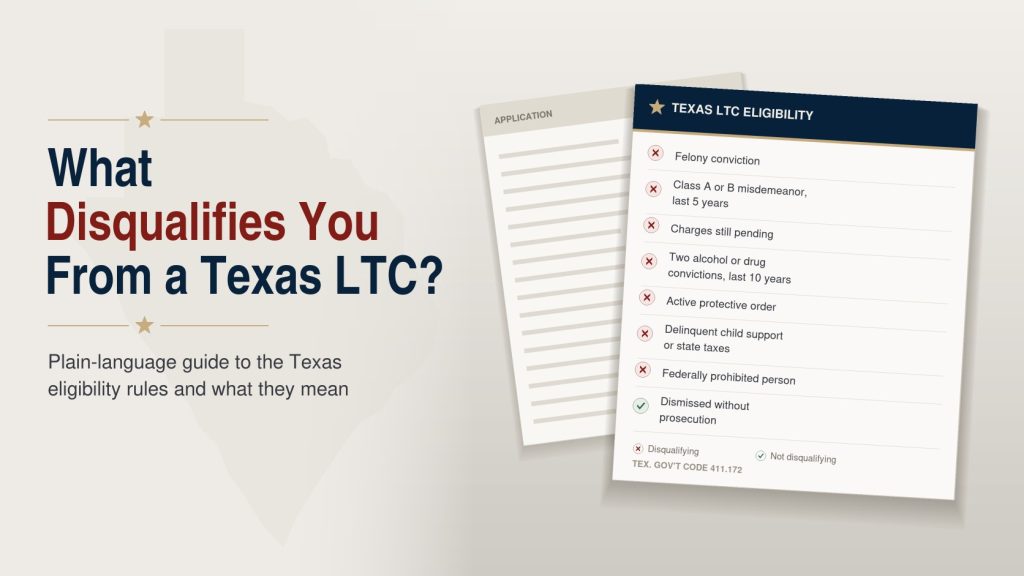
Texas Government Code Section 411.172 sets the eligibility rules for a License to Carry. The most common disqualifiers are a felony conviction, a Class A or Class B misdemeanor conviction in the last five years, charges that are still pending, two alcohol or drug related convictions in the last ten years, an active protective order, a final determination that you are behind on child support or on money owed to the state, and anything that makes you a prohibited person under federal law. Deferred adjudication usually counts as a conviction. Texas DPS makes the final call.
Texas Keeps the Eligibility Rules in One Law
Almost everything on this page comes from one place: Texas Government Code Chapter 411, Subchapter H. Section 411.172 is the eligibility section, it is public, and it is linked at the bottom of this page.
One thing helps before you read it. The statute is written as a list of things you must be, not things you must avoid. It says a person qualifies if they have not been convicted of a felony, and so on down the line. It reads backward at first, then it is easy to follow.
Texas law is also only half the picture. Federal law has its own list of people who may not have a firearm at all, and Texas builds that list into its own requirements. That is covered further down.
Felony Convictions Are the Clearest Disqualifier
A felony conviction disqualifies you from a Texas LTC. There is no waiting period that fixes it.
Texas defines this broadly on purpose. Under Section 411.172(b), an offense counts as a felony if the state designates it a felony, if it contains all the elements of an offense the state designates a felony, or if it is punishable by confinement for one year or more in a penitentiary. That last part matters for out-of-state convictions, which can count even if the other state used a different word.
Federal law lines up here. A person convicted of a crime punishable by more than one year in prison is prohibited from having a firearm under federal law, so they also cannot meet the Texas requirement to be fully qualified to buy a handgun.
If a felony conviction was later expunged, pardoned, set aside, annulled, voided or sealed, Texas does not treat it as a conviction. Section 411.171 says so directly. That is a narrow door and a legal question, not a paperwork question. If you think it applies to you, ask a Texas attorney rather than guessing.
Class A and Class B Misdemeanors Have a Five Year Window
This is the disqualifier that surprises people most, and it is the one that expires.
Section 411.172(a)(8) says an applicant must not have been convicted, in the five years before the date of application, of a Class A or Class B misdemeanor, or of an offense under Section 42.01 of the Penal Code, which is disorderly conduct.
So a Class A or Class B misdemeanor is not permanent. It blocks the application for five years from the conviction, then it stops blocking it. DPS gives the everyday example itself: on its eligibility page, DPS explains that driving while intoxicated is at least a Class B misdemeanor, and that an applicant is ineligible for five years after that conviction.
If you are near the five year mark, the date matters. The statute measures back from the date of your application, not the date you take a class.
Pending Charges Pause an Application
You do not have to be convicted of anything for a pending case to matter. Section 411.172(a)(4) says an applicant must not be currently charged with a Class A or Class B misdemeanor, an offense under Section 42.01, or a felony under an information or indictment.
Being charged is not the same as being guilty, and the statute is not saying otherwise. It is saying the state waits for the outcome before issuing a license. Subsection (a)(5) separately covers anyone who is a fugitive from justice for a felony or a Class A or Class B misdemeanor.
The practical version: if a case is open, it needs to close first.
Deferred Adjudication Counts as a Conviction
This one causes more confusion than anything else on the list.
Deferred adjudication is an outcome where a judge does not enter a finding of guilt. You complete community supervision, and the case is dismissed at the end. Many people finish it and reasonably believe they were never convicted of anything.
For LTC purposes, Texas treats it differently. Section 411.171 defines "convicted" to include an order of deferred adjudication, whether or not the sentence was probated and the person was later discharged. DPS says the same thing plainly on its eligibility page, and adds that a deferred adjudication is not the same as a dismissal without prosecution.
That distinction is the key one:
- A charge dismissed without prosecution is not disqualifying, according to DPS.
- A deferred adjudication is treated as a conviction.
There is an exception, and it has a time limit. Section 411.1711 says a person is not considered convicted if the deferred adjudication order was entered at least ten years before the date of the application. That exception does not apply to certain serious offenses, including felony offenses under Title 5 of the Penal Code, robbery under Chapter 29, violations of certain court orders under Sections 25.07 and 25.072, and some burglary offenses under Section 30.02.
If your situation involves deferred adjudication, this is the single best reason on this page to talk to a Texas attorney before you apply. The rules interact, the dates matter, and a general article cannot sort out a specific record.
Alcohol and Drug Convictions Have Their Own Rule
Texas has a separate provision aimed at repeat intoxication offenses. Section 411.172(a)(6) says an applicant must not be a chemically dependent person. Section 411.172(c) then defines a specific trigger: a person convicted two times within the ten years before applying, of an offense of Class B misdemeanor grade or greater that has the use of alcohol or a controlled substance as a statutory element, is a chemically dependent person for this purpose and does not qualify.
Two convictions. Ten years. That is the line the statute draws.
A single DWI is handled by the five year misdemeanor rule above. A second one inside ten years reaches this provision instead, and this provision is not written as a waiting period.
DPS also notes that lawful participation in the Texas Compassionate Use Program does not by itself make someone ineligible, though the underlying medical condition can still be reviewed if it affects judgment about the use and storage of a handgun.
Protective Orders and Restraining Orders
Section 411.172(a)(12) says an applicant must not be currently restricted under a court protective order, or subject to a restraining order affecting the spousal relationship, other than a restraining order that only affects property interests.
Read the word "currently." This one is about your situation on the day you apply.
Federal law adds to it. Federal law prohibits firearm possession by a person subject to a court order restraining them from harassing, stalking or threatening an intimate partner or a child of an intimate partner, and separately prohibits anyone convicted of a misdemeanor crime of domestic violence. That federal domestic violence bar has no five year clock on it.
One provision runs the other direction. Section 411.172(i) allows an 18, 19 or 20 year old who is protected under an active protective order, or a magistrate's order for emergency protection, to apply.
Child Support and Money Owed to the State
Two disqualifiers on the list have nothing to do with criminal history, and people rarely see them coming.
Section 411.172(a)(10) says an applicant must not have been finally determined to be delinquent in making a child support payment administered or collected by the attorney general.
Section 411.172(a)(11) says an applicant must not have been finally determined to be delinquent in the payment of a tax or other money collected by the comptroller, a local tax collector, or any agency or subdivision of the state.
The phrase carrying the weight is "finally determined." This is not about being a little behind this month; it refers to a formal determination. Still, if you know there is an open child support enforcement matter or a state tax issue, it is better to find out where it stands before you apply than to learn about it from a denial letter.
Juvenile Records From the Last Ten Years
Section 411.172(a)(13) says an applicant must not have been adjudicated, in the ten years before the date of application, as having engaged in delinquent conduct that violated a penal law of the grade of felony.
Two limits are built into that sentence: it applies to felony grade conduct, and it looks back ten years. A juvenile matter older than that, or below felony grade, is not what this provision reaches.
Federal Law Applies on Top of Texas Law
Section 411.172(a)(9) requires an applicant to be fully qualified under applicable federal and state law to purchase a handgun. That single line pulls all of federal firearms law into the Texas eligibility test.
Under federal law, the categories prohibited from having firearms or ammunition include a person who:
- has been convicted of a crime punishable by imprisonment for more than one year
- is a fugitive from justice
- is an unlawful user of, or addicted to, a controlled substance
- has been adjudicated as a mental defective, or committed to a mental institution
- is unlawfully in the United States
- was discharged from the Armed Forces under dishonorable conditions
- has renounced United States citizenship
- is subject to certain court orders protecting an intimate partner or their child
- has been convicted of a misdemeanor crime of domestic violence
A separate federal provision also restricts a person who is under indictment for a crime punishable by more than one year.
Two of these deserve a note. Marijuana remains a controlled substance under federal law even where a state has legalized it, which is why the unlawful user category surprises people. And the discharge category is narrow: dishonorable conditions specifically, not any less than honorable discharge. If you served, our guide for military members and veterans applying for a Texas LTC has more.
Mental Health and the Sound Judgment Standard
Section 411.172(a)(7) says an applicant must not be incapable of exercising sound judgment about the proper use and storage of a handgun. Subsections (d) through (f) explain what that means, and they are more specific than people expect.
A person is considered incapable if a licensed physician has diagnosed them with a psychiatric disorder or condition that causes, or is likely to cause, substantial impairment in judgment, mood, perception, impulse control or intellectual ability. It also covers a condition in remission that is reasonably likely to redevelop, a determination of incompetency to manage one's own affairs, and a plea of not guilty by reason of insanity.
Subsection (f) is the part worth knowing. A person previously diagnosed may still qualify by providing a certificate from a licensed physician whose primary practice is psychiatry, stating the condition is in remission and is not reasonably likely to develop at a future time.
So a past diagnosis is not automatically the end of the road. There is a defined path, and it runs through a doctor rather than a course provider.
Age and Residency Are Separate Questions
Age and residency are eligibility requirements, but they are not disqualifiers in the way the rest of this list is, and each has its own article.
On age, the statute says 21. Texas DPS has said it will not deny an otherwise eligible applicant only for being 18, 19 or 20, because of a federal court ruling. Both statements are current at once, which is confusing enough that we wrote how old you have to be to get a Texas LTC about exactly that.
On residency, living in another state does not disqualify you. Texas issues licenses to nonresidents; what changes is the paperwork. See whether you have to be a Texas resident.
Leaving Something Off the Application Is Its Own Problem
Section 411.172(a)(14) says an applicant must not have made any material misrepresentation, or failed to disclose any material fact, in the application.
This is the disqualifier people create for themselves, and it is entirely avoidable.
Texas DPS instructs applicants to report all arrests, including arrests that ended in dismissal or acquittal, with the year, the offense, the location and the outcome. DPS also warns that failing to provide requested documentation can result in an application being terminated as incomplete.
So the honest approach is also the strategic one. An old arrest that ended in a dismissal is not disqualifying. Leaving it off the form is a separate problem, and a worse one. DPS runs a fingerprint based state and FBI background check on every original applicant, so the record gets reviewed either way. Fingerprinting has its own step.
What to Do If Something in Your Past Worries You
A sensible order of operations:
- Read the statute yourself. Section 411.172 is linked below. It is shorter than you expect.
- Write down your own dates. The date of a conviction, the date a deferred adjudication order was entered, the date a case was dismissed. Several rules here are date driven, and vague memory is not good enough.
- Get your records if you are unsure. DPS provides procedures for reviewing and challenging Texas and FBI criminal history records.
- Ask a Texas attorney about anything unclear. Especially deferred adjudication, out-of-state convictions, expunctions and protective orders.
What not to do is ask a class provider to rule on your eligibility. First Shot Training teaches the classroom portion and explains the process. It does not decide who qualifies, and it cannot promise DPS will approve anyone. That is not modesty; it is how the law is set up. Our broader page on Texas LTC eligibility makes the same point.
If DPS Denies the Application, There Is a Review Process
A denial is not automatically the end. Section 411.180 requires DPS to give written notice stating the reason for a denial, revocation or suspension. Within 30 days after receiving that notice, the applicant or license holder may request a hearing.
The hearing is held in a justice court in the county where the person lives, with a justice of the peace acting as the hearing officer. The court decides whether the denial is supported by a preponderance of the evidence. A party who disagrees may appeal to a county court at law, where the case is tried again without a jury.
You do not need to memorize that. It is worth knowing the statute builds in a route to have a decision reviewed, and that the route has a 30 day clock on it, which we walk through step by step in what happens if your Texas LTC application is denied.
Where the Online Class Fits In
If you have read this far and nothing on the list applies to you, the honest next step is to stop researching and start the education.
DPS requires the classroom course to cover four topics: laws relating to weapons and the use of deadly force, handgun use and safety, nonviolent dispute resolution, and proper storage practices with an emphasis on preventing accidental injury to a child. DPS allows that classroom portion to be completed online through an approved online course provider. After you pass it, you still demonstrate handgun proficiency with a qualified Texas LTC instructor and submit your application to DPS.
The class does not decide eligibility and does not replace the background check. It teaches the material the state wants every license holder to know, including where the law says you may not carry, which we cover in where you cannot carry a handgun in Texas. For the full sequence and the cost, see how the Online Texas LTC Class works and what a Texas LTC costs.
One last note, the same one we would give a friend. Laws change, courts interpret them, and the details of a record matter more than any general article can account for. This page describes what Texas law currently lists. If you have a real question about your own history, a Texas attorney is the right person to ask, and asking early is cheaper than asking late.
Official Texas Sources
- Texas Government Code Chapter 411, Subchapter H, including Section 411.171 definitions, Section 411.172 eligibility, Section 411.1711 exemptions from convictions, and Section 411.180 review of a denial
- Texas DPS, Handgun Licensing Eligibility FAQs
- Texas DPS, Handgun Licensing Service
- ATF, Identify Prohibited Persons, for the federal categories under 18 U.S.C. 922(g)
- Texas State Law Library, Gun Laws: License to Carry
Frequently Asked Questions
Does a DWI disqualify you from getting a Texas LTC?
For a period, yes. Texas DPS states that driving while intoxicated is at least a Class B misdemeanor and that an applicant is ineligible for five years after that conviction. A second alcohol or drug related conviction of Class B misdemeanor grade or greater within ten years is handled by a different provision, Section 411.172(c), which is not written as a waiting period.
Does deferred adjudication count against a Texas LTC application?
Usually yes. Texas Government Code Section 411.171 defines u003cstrongu003econvictedu003c/strongu003e to include an order of deferred adjudication, and DPS says plainly that a deferred adjudication is not the same as a dismissal without prosecution. Section 411.1711 provides a limited exception once ten years have passed since the order, and that exception does not apply to certain serious offenses. This is the part of the law most worth asking a Texas attorney about.
Can you get a Texas LTC with a felony conviction?
No. Section 411.172(a)(3) requires that an applicant has not been convicted of a felony, and there is no waiting period that clears it. Federal law separately prohibits firearm possession after a conviction punishable by more than one year in prison. A conviction that has been expunged, pardoned, set aside or sealed is treated differently under Section 411.171, which is a legal question rather than a paperwork one.
How long does a Class A or Class B misdemeanor keep you from getting a Texas LTC?
Five years. Section 411.172(a)(8) looks back five years from the date of your application. After that window the conviction no longer blocks the application on that basis, although every other eligibility rule still applies and DPS still makes the decision.
Do you have to report an arrest that was dismissed?
Yes. Texas DPS instructs applicants to report all arrests, including arrests that ended in dismissal or acquittal, with the year, offense, location and outcome. A charge dismissed without prosecution is not disqualifying, but leaving it off the form can be a problem of its own, because Section 411.172(a)(14) covers material misrepresentation and failure to disclose a material fact.
What happens if Texas DPS denies your LTC application?
Section 411.180 requires DPS to give written notice stating the reason. Within 30 days after receiving that notice, the applicant may request a hearing, which is held in a justice court in the county where the person lives. A party who disagrees with the result may appeal to a county court at law, where the case is tried again without a jury.
Disclaimer: The information provided in this article is for general educational and informational purposes only and should not be considered legal advice. First Shot Training is not a law firm and does not provide legal advice. While we make every reasonable effort to ensure the information we publish is accurate and up to date at the time of publication, laws, regulations, licensing requirements, reciprocity agreements, and government policies may change without notice. You are responsible for verifying current information with official government sources before relying on any information contained in this article. If you have questions regarding how the law applies to your specific circumstances, consult a qualified attorney licensed in your jurisdiction.