
Table of Contents
The Question Asked From the Other Direction
Most carry reciprocity writing is aimed at people leaving. You have a Texas license, you are driving to see family in another state, and you want to know whether your card travels with you.
This page answers the opposite question. You hold a permit from another state, and you are coming to Texas. Maybe you are driving through on the way to somewhere else. Maybe you are here for a week of work. Maybe you just accepted a job in Dallas and the moving truck is booked.
Does Texas honor the permit already in your wallet?
The answer is short and it got shorter in 2025. This page explains what Texas recognizes, what recognition does not do, and what changes once you actually live here. It is general education, not legal advice about your situation. Only a Texas attorney can tell you how the law applies to your own circumstances.
Quick Answer: Texas Recognizes All Valid Out-of-State Handgun Licenses
Here is the short version.
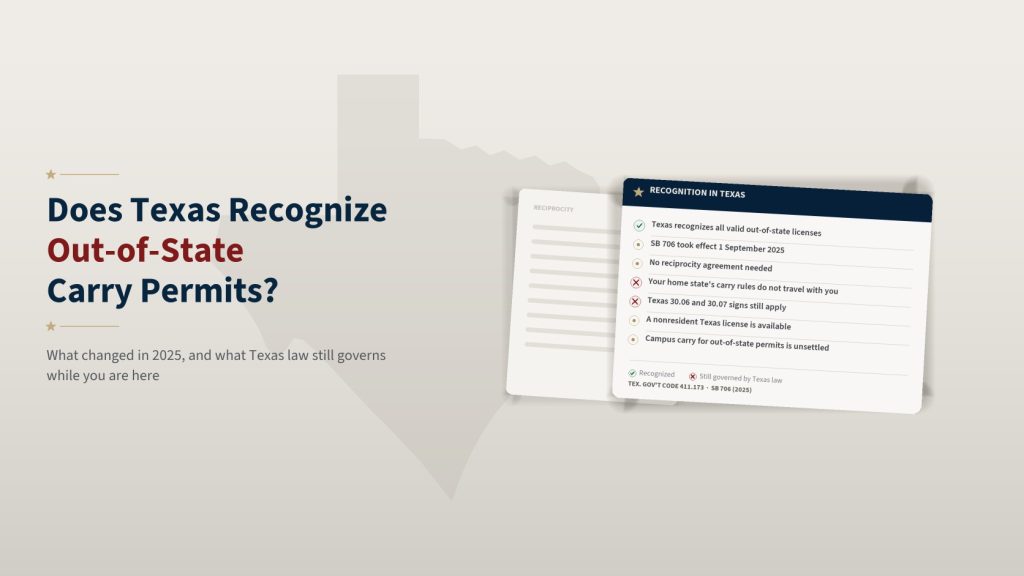
- Texas recognizes every valid out-of-state handgun license. Texas Government Code Section 411.173(b) now reads: "A valid license to carry a handgun issued by any other state is recognized in this state."
- There is no list of approved states to check for this. Recognition is not conditioned on which state issued your permit.
- This changed in 2025. Senate Bill 706 removed the old requirement that the governor negotiate reciprocal agreements before Texas would recognize another state's license.
- Recognition does not import your home state's rules. While you are in Texas, Texas law governs where and how you carry.
- Texas signage applies to you. The 30.06 and 30.07 notices posted at Texas businesses apply to anyone carrying here.
- Texas restricted locations apply to you. Penal Code Sections 46.03 and 46.035 do not have a visitor exception.
- A nonresident Texas LTC exists for people who qualify but do not live here, and for people relocating with the intent to establish residency.
So the headline is genuinely good news. The details underneath it are where the useful part lives.
What the Statute Says Now
Texas Government Code Section 411.173 is the recognition statute. Subsection (b), as amended, is one sentence:
A valid license to carry a handgun issued by any other state is recognized in this state.
That is the whole rule for the inbound direction. There is no qualifier about which state, no evaluation of that state's training standards, and no requirement that your state honor Texas licenses in return.
Two words in that sentence still do work, though.
Valid. An expired permit is not a valid license. A suspended or revoked permit is not a valid license. Recognition attaches to a license that is actually in force, so check your own expiration date before you cross the state line.
License to carry a handgun. The statute is about handgun carry licenses issued by states. It is not a general recognition of every firearms-related document a state might issue.
What Changed in 2025
If you looked this up two years ago, you found a more complicated answer. That is because the statute used to work differently.
Senate Bill 706 passed in the 89th Texas Legislature's 2025 Regular Session, Chapter 483, and took effect on 1 September 2025. It made two changes that matter.
First, it removed the requirement that the governor negotiate reciprocal agreements as a precondition to recognition. Under the old system, recognition of another state's license depended on an agreement being in place. No agreement, no recognition.
Second, it repealed Section 411.173(c) and (d). Those subsections had required evaluating other states' licensing and background-check processes before Texas would recognize their licenses. Texas used to ask whether another state's standards were close enough to its own. It does not ask that anymore.
The practical effect is that a question which used to require checking a chart now has a one-sentence answer. If your license is valid, Texas recognizes it.
Why the Old System Left Behind So Much Confusion
Reciprocity information ages badly, and this is a good example of why.
For years, carry reciprocity was genuinely a state-by-state puzzle. Agreements existed with some states and not others, they got renegotiated, and the maps that everyone shared online were often out of date the month after they were published. People developed the habit of checking before every trip, which was the right habit for the law as it stood.
That habit is still worth keeping for other states. It is no longer necessary for the inbound Texas question specifically, and a fair amount of material written before September 2025 has not caught up. If you find a page telling you to verify whether Texas has an agreement with your state before you visit, you are reading something the Legislature has since simplified.
The broader debate about how carry recognition ought to work nationally is a separate conversation, and a lively one. For the narrow inbound question this page is about, Texas has already settled it.
The Outbound Direction Is a Separate Question
There is one place the governor still negotiates agreements, and it runs the other way.
Some states will not honor a Texas License to Carry unless a formal agreement is in place. Texas still negotiates those agreements, because that is what the other state requires. That is entirely about Texas license holders traveling outward. It has nothing to do with whether Texas honors your permit while you are here.
Keep the two directions separate in your head and this stops being confusing:
- Inbound. Another state's license, used in Texas. Governed by Section 411.173(b). All valid licenses recognized.
- Outbound. A Texas license, used in another state. Governed by that state's law. Varies by state.
If you also hold a Texas license, or you are thinking about getting one, our page on which states honor a Texas License to Carry covers the outbound side in detail.
Section 411.173 also requires DPS to maintain a published list of states that recognize Texas licenses, updated annually. Note what that list is for. It is the outbound reference, telling Texas license holders where their card is honored. It is not a list of permits Texas accepts, because Texas accepts them all.
Recognition Does Not Import Your Home State's Rules
This is the most important paragraph on this page, and it is the point secondary sources most often skip.
Texas recognizing your license means Texas treats you as a licensed carrier. It does not mean your home state's carry rules come with you.
While you are in Texas, Texas law governs where you may carry and how. The restrictions in Texas Penal Code Sections 46.03 and 46.035 apply to you exactly as they apply to a Texas license holder. If your state permits carry somewhere Texas does not, your permit does not create an exception. If your state has no signage system, Texas signage still binds you.
Think of it this way. Recognition answers the question "is this person licensed." It does not answer the question "what may a licensed person do in Texas." Texas answers that second question for itself, and the answer is the same for everyone carrying inside its borders.
That is not unusual. Most states work this way. But people do get caught by it, usually because they spent years learning one state's rules and assumed the rules were roughly the same everywhere. They are not.
Texas Rules on Where You Can Carry
So if you are visiting, the useful homework is not about reciprocity. It is about Texas restricted locations and Texas signs.
Texas Penal Code Sections 46.03 and 46.035 set out categories of places where carrying is restricted. Our page on where you cannot carry a handgun in Texas walks through those categories in plain language, and it is worth twenty minutes of your time before a trip.
Texas also has a signage system that private property owners use to give notice. The 30.06 sign addresses concealed carry and the 30.07 sign addresses open carry, with specific requirements for wording and posting. These signs are common at Texas businesses, and they apply to anyone carrying here, not only to Texas license holders. If you have never seen them, our page on Texas 30.05, 30.06 and 30.07 signs shows what each one is and what it means when you see it on a door.
Property owners in Texas have real authority over their own premises. Respecting a posted sign is both the law and simply good manners in a state that takes property rights seriously.
The Campus Question Is Not Settled
One question deserves a careful answer instead of a confident one.
Carrying a handgun on a Texas college campus requires a license under Texas Government Code Section 411.2031, and permitless carry does not reach a campus. Whether an out-of-state permit satisfies that statute is genuinely unresolved. The statute speaks in terms of a "license holder," and the question has not been settled.
We are not going to tell you it works, and we are not going to tell you it does not. If you hold an out-of-state permit and campus is relevant to you, confirm it with the institution and with a Texas attorney before relying on it. Our full walkthrough of Texas campus carry covers how the statute operates and why campus is treated differently from everywhere else.
If You Are Just Passing Through
For a visitor, the picture is straightforward.
Your valid permit is recognized. Carry the physical license with you, keep it current, and understand that Texas rules govern your conduct while you are here. Read the restricted locations, learn the signs, and behave the way you would want a visitor to behave in your own state.
One more piece of practical preparation: know how a traffic stop works here. Texas has its own customs and expectations for interactions with law enforcement while carrying, and knowing them in advance makes a routine stop stay routine. Our page on being stopped while carrying in Texas covers what to expect and how to keep the encounter calm and simple.
It is also worth knowing that Texas allows permitless carry for eligible adults 21 and over, which means many lawful carriers in Texas are not licensed at all. That does not change anything for you if you hold a permit. It is just useful context for why carry looks different here than it may at home.
If You Are Moving to Texas
Relocation is the other big audience for this question, and the answer has a second half.
Your out-of-state permit is recognized in Texas, so you are not in a gap on day one. That is a relief for a lot of people mid-move, and it is worth knowing before the truck pulls out of your old driveway.
But recognition and a Texas license are not the same thing, and once Texas is home, several benefits belong specifically to a Texas License to Carry.
Campus carry. As covered above, the campus statute is written around a "license holder," and whether an out-of-state permit qualifies is unresolved. A Texas license removes the uncertainty.
The firearm purchase background-check exemption. A valid Texas LTC can stand in for the point-of-sale check at a licensed dealer. Our page on the Texas LTC firearm purchase background-check exemption explains how that works.
Outbound reciprocity. Other states honor a Texas license on their own terms, and DPS publishes the annually updated list of states that do. Once you live here, that is the card you want doing the traveling.
None of that is urgent on moving day. It is simply the reason most people who settle in Texas eventually get a Texas license, and knowing it in advance saves you from being surprised later.
The Nonresident Texas License
Texas also issues licenses to people who do not live here, and this is a genuinely useful option that many people do not know exists.
Section 411.173(a) requires DPS to establish a procedure for a person who meets all eligibility requirements except Texas residency. The statute covers two situations: a person who "is a legal resident of another state" and a person who "relocates to this state with the intent to establish residency."
That second phrase matters if you are mid-move. You do not have to have finished establishing Texas residency to begin the process.
A few practical points:
- Nonresident applicants submit form LTC-6, along with a copy of the out-of-state driver license or state identification card.
- Nonresident licenses expire under Section 411.183, the same term rules that apply to any Texas license.
- They renew under Section 411.185, the same renewal process as any other Texas license.
In other words, a nonresident license is a Texas license. It is not a lesser document with its own separate lifecycle. The difference is in how you apply, not in what you hold afterward.
Our pages on whether you have to be a Texas resident to get an LTC and applying with an out-of-state driver license cover the details, and if you are completing the coursework from outside Texas, taking the online Texas LTC class from out of state explains how that piece works.
The Honest Summary
Does Texas honor your out-of-state carry permit? Yes. Every valid one, from every state, with no chart to check and no agreement required. Section 411.173(b) says so in a single sentence, and Senate Bill 706 made it that simple in September 2025.
That is the easy half. The half that actually requires attention is what recognition does not do. Your permit does not bring your home state's rules across the state line. Texas restricted locations apply to you. Texas signs apply to you. The campus question is unresolved and should be treated that way.
So the useful preparation for a trip to Texas is not verifying reciprocity. It is spending a little time with Texas rules on where you can carry, learning to recognize the signs, and knowing how a stop works here.
And if Texas is about to be home rather than a stop along the way, your permit covers you in the meantime while you look at whether a Texas license makes sense for the life you are building here. That is a decision worth making with good information rather than in a hurry.
Frequently Asked Questions
Does Texas recognize out-of-state concealed carry permits?
Yes. Texas Government Code Section 411.173(b) now provides that a valid license to carry a handgun issued by any other state is recognized in this state. Texas recognizes all valid out-of-state handgun licenses.
What changed in 2025 for out-of-state permits in Texas?
Senate Bill 706, effective 1 September 2025, removed the requirement that the governor negotiate reciprocal agreements before Texas would recognize another state’s license, and repealed the provisions that required evaluating other states’ licensing processes first.
Do your home state’s carry rules apply while you are in Texas?
No. Recognition means Texas honors the license itself. Texas law governs where and how you may carry while you are here, including the restrictions in Texas Penal Code Sections 46.03 and 46.035 and Texas 30.06 and 30.07 signage.
Can a non-resident get a Texas License to Carry?
Yes. Section 411.173(a) requires DPS to provide a procedure for a person who meets every eligibility requirement except Texas residency, either as a legal resident of another state or as someone relocating to Texas with the intent to establish residency. Non-resident applicants submit form LTC-6 with a copy of their out-of-state driver license or state ID.
Does an out-of-state permit work for Texas campus carry?
That question is not settled. Section 411.2031 speaks in terms of a license holder, and we are not going to guess at how it applies to an out-of-state permit. Anyone relying on it should confirm with the institution and with a Texas attorney first.
Disclaimer: The information provided in this article is for general educational and informational purposes only and should not be considered legal advice. First Shot Training is not a law firm and does not provide legal advice. While we make every reasonable effort to ensure the information we publish is accurate and up to date at the time of publication, laws, regulations, licensing requirements, reciprocity agreements, and government policies may change without notice. You are responsible for verifying current information with official government sources before relying on any information contained in this article. If you have questions regarding how the law applies to your specific circumstances, consult a qualified attorney licensed in your jurisdiction.