
Table of Contents
The Part of Licensing Nobody Talks About
Almost everything written about the Texas License to Carry is about getting one. The class, the test, the range, the application. Very little is written about the years afterward, when the license is just a card in your wallet and life keeps happening around it.
But life does keep happening. People move. People marry and change their names. Wallets get left on gas pumps and cards get stolen out of glove boxes. And some people find themselves in circumstances where they need a license faster than the ordinary process would provide.
Texas has rules for all of it, and most of them come with a deadline attached. This page walks through what to do when your license needs to be updated or replaced, including the At-Risk designation that very few sites cover at all. It is general education, not legal advice about your situation. Only Texas DPS can act on your license, and only a Texas attorney can advise you about your own circumstances.
Quick Answer: Updating or Replacing a Texas LTC
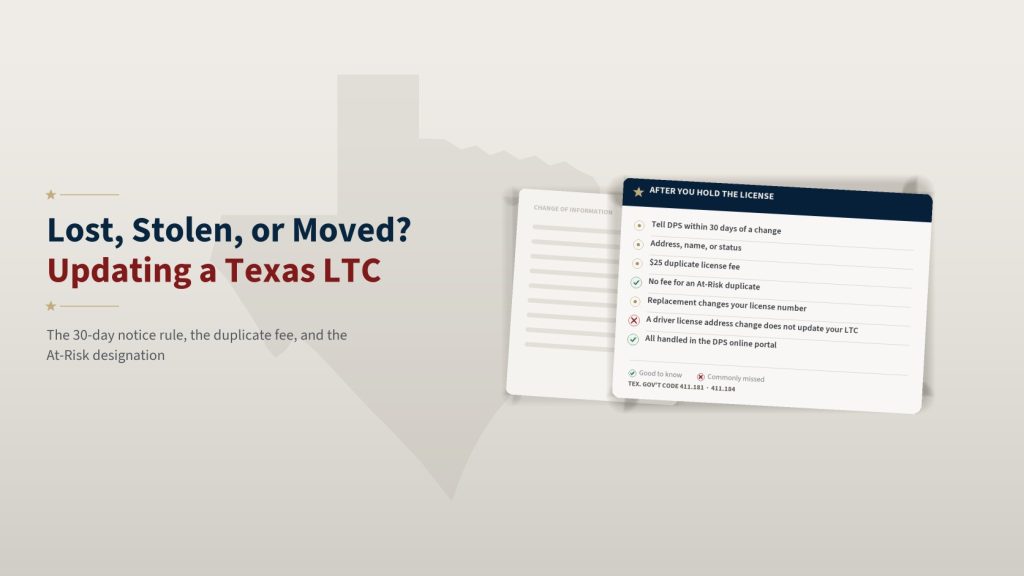
- You have 30 days. Under Texas Government Code Section 411.181, a license holder must notify DPS not later than the 30th day after a change of address, name, or status. You give your license number and the updated information.
- Lost, stolen or destroyed? You must apply for a duplicate not later than the 30th day after the loss, theft or destruction.
- A duplicate license costs $25. That figure is set in Section 411.181.
- Money saver: if your license expires within 60 days of the loss, theft or destruction, you may renew instead and pay only the renewal fee rather than the duplicate fee.
- A replaced license gets a new number. DPS changes the license number when it replaces a lost or stolen card, for security reasons.
- Your driver license address does not carry over. DPS says it plainly: "Changing the address on your Texas Driver License or ID Card will not automatically change the address on your LTC."
- The At-Risk designation exists. Section 411.184 requires DPS to provide an expedited path for people at increased risk of becoming a victim of violence.
- All of it happens here: https://txapps.texas.gov/txapp/txdps/ltc/
The 30-Day Rule, and Why It Exists
Section 411.181 puts an ongoing duty on you, not on the state. Within 30 days of a change of address, name or status, you notify DPS, and you give them your license number along with the updated information.
That deadline is not busywork. A license is a live record, and the state needs the record to match the person. When it does not, small problems compound. A renewal notice goes to a house you sold. A name on a card no longer matches the name on your driver license, which makes an ordinary traffic stop more complicated than it needed to be.
Thirty days is generous if you handle it in the first week and tight if you forget about it for a month. The fix is simple. Whenever a life change happens, add DPS to the same mental list as the bank, the insurance company and the post office.
Keeping the record accurate is part of holding a license responsibly. It is the same instinct that made you take the training seriously in the first place, and if you want a refresher on the broader duties that come with the license, our page on Texas LTC requirements is a good starting point.
Changing Your Address
This is the most common update by a wide margin, and it is also the one most often skipped.
You moved. You updated your driver license, forwarded your mail, called the utility company, and considered the matter closed. Your LTC record, however, still points at your old street.
Log into the DPS portal, choose the address change function, and update it. It takes a few minutes.
Why it matters more than it looks: DPS is required to mail you a renewal notice not later than the 60th day before your license expires. That notice goes to the address on file. If the address is wrong, the notice lands in someone else's mailbox and you never see it. Plenty of expired licenses started as an unreported move. We walk through the renewal timeline and how to protect yourself from exactly this in how to renew your Texas LTC.
Your Driver License Address Does Not Update Your LTC
This deserves its own section because it catches so many people, including careful people.
DPS states it directly:
"Changing the address on your Texas Driver License or ID Card will not automatically change the address on your LTC."
Two records. Two updates. They live in related systems but they are not the same file, and updating one does not touch the other.
If you have moved at any point since your license was issued and you cannot specifically remember updating your LTC address, assume you did not. Log in and check. It takes less time than reading this paragraph took, and it may save you from missing a renewal notice years from now.
Changing Your Name
A name change follows the same 30-day rule. Marriage, divorce, a court-ordered change: if the name on your license is no longer your legal name, DPS needs to know within 30 days.
Handle it in the portal along with your other records. And keep an eye on consistency across your documents. When your driver license, your LTC and your other identification all agree, everyday encounters stay simple. When they disagree, you end up explaining paperwork at moments when you would rather not be explaining anything.
Lost, Stolen, or Destroyed
Cards go missing. It happens to organized people.
Texas gives you a deadline here too: you must apply for a duplicate not later than the 30th day after the loss, theft or destruction. Destroyed counts, which covers the card that went through the wash, the one that melted on a dashboard, and the one a dog decided was food.
Report it and request the duplicate through the DPS portal, which has a dedicated function for reporting a license lost or stolen. If the card was stolen as part of a theft you reported to law enforcement, keep your report information handy.
Do not delay on this. A missing license is not just an inconvenience. It is a state-issued credential with your name on it that you can no longer account for, and the state has a legitimate interest in knowing that promptly.
The $25 Duplicate Fee, and When You Can Skip It
A duplicate license costs $25, set in Section 411.181.
Here is the detail almost nobody mentions, and it is worth real money to the right person.
If your license expires within 60 days of the loss, theft or destruction, you may renew instead of replacing, and pay only the renewal fee rather than the duplicate fee.
Think about what that saves you. Without this provision, someone whose license disappeared two months before expiration would pay $25 for a duplicate and then turn around and pay the renewal fee shortly after, for a card they had barely held. The statute lets you skip straight to the renewal.
So before you click the duplicate option, look at the expiration date on your license, or look it up if the card itself is gone. If you are inside that 60-day window, renew instead. The renewal fee is $40 and it comes with a fresh five-year term, which is a far better outcome than $25 for a card that expires in six weeks.
Your License Number Will Change
When DPS replaces a lost or stolen license, the license number changes. DPS does this for security reasons, and the logic is straightforward: a number that may be circulating on a card you no longer control is a number worth retiring.
Practically, that means anywhere you have recorded your old license number, the record is now stale. Take a few minutes after your new card arrives and update your own notes. Confirm the new number is printed correctly on the card while you are at it.
It also matters at a gun counter. A valid Texas LTC can stand in for the point-of-sale background check, and dealers verify the license they are shown. Presenting a number that no longer belongs to a live license makes for an awkward stop at the counter. We explain how that exemption works in the Texas LTC gun purchase background check exemption.
The At-Risk Designation
This section is for a reader who may be having a very hard time. We will keep it plain and practical.
Texas Government Code Section 411.184 was added by House Bill 2675, passed by the 87th Texas Legislature in its 2021 Regular Session, Chapter 821, effective 1 September 2021. It says this:
"The department shall develop a procedure for persons who are at increased risk of becoming a victim of violence to obtain a handgun license on an expedited basis."
That is the whole idea. The Legislature recognized that the ordinary licensing timeline does not fit every situation, and it directed DPS to build a faster path for people at increased risk.
We want to be careful about two things here.
First, we are not going to promise you a number of days. Section 411.184 sets no numeric deadline, and DPS does not publish a service level figure for it. What the statute provides is that the process is expedited and that DPS sets the procedure. Anyone quoting you a specific turnaround is guessing.
Second, and more important: a license is one piece of a safety plan, and it is not the first piece. If you are in a situation involving threats or violence, please talk to a Texas attorney about your options and to a local advocacy organization about safety planning. Those conversations are about your actual circumstances, which is something no article can address. Family violence programs and legal aid organizations exist in every part of Texas, and they do this work every day.
What Counts as Qualifying Evidence for At-Risk
Section 411.184 names the documentation that supports an At-Risk request. Any of the following qualifies:
- A temporary restraining order or temporary injunction issued under Family Code Chapter 6
- A temporary ex parte order under Family Code Chapter 83
- A protective order under Family Code Chapter 85, or under Code of Criminal Procedure Chapter 7B
- A magistrate's order for emergency protection under Code of Criminal Procedure Article 17.292
- Participation in the address confidentiality program under Code of Criminal Procedure Chapter 58
The statute also allows the DPS director to accept alternative documentation by rule, so the list is not necessarily the end of the conversation.
If you already have one of these documents, keep a clean copy of it. If you are not sure whether something you were given fits one of these categories, that is a question for the attorney or advocate helping you, not something to guess at on a form.
DPS recognizes both "Protective Order" and "At Risk" as special conditions on its application, and the online portal explicitly supports updating At-Risk status. So this is not a hidden path. It is built into the system you already use.
No Fee, and Yearly Recertification
Two practical points about the At-Risk designation.
There is no fee. DPS issues a duplicate license with the At-Risk designation at no charge. And when a person no longer qualifies for the designation, DPS issues a duplicate without it, also at no charge. The state does not charge you to add the designation or to remove it later.
Annual recertification is required. The designation is not permanent by default. It has to be recertified each year to stay in place. Put that on your calendar the same way you would put your license expiration date there. A designation that lapses because nobody remembered the date is a preventable loss.
If your circumstances change and you no longer qualify, the removal is handled the same way, through the portal, without a fee.
When a License Can End Earlier Than You Expect
Most license holders think of their term as fixed. Under Section 411.183, a license can end earlier in two situations worth knowing about.
The first is tied to a protective order. If a license was issued in connection with a protective order, the expiration of that order can affect the license term.
The second is lawful presence in the United States. If a person's lawful presence expires before the license term would otherwise run out, the license expires then.
Neither of these applies to most Texas license holders, but both are in the statute, and it is better to know they exist than to be surprised. If either might touch your situation, a Texas attorney is the right person to ask. Our general overview of Texas LTC eligibility covers the broader framework of who the license is available to.
How to Handle All of This Online
Every task on this page runs through the same place:
https://txapps.texas.gov/txapp/txdps/ltc/
That portal handles original applications, instructor certification, renewals, address changes, lost or stolen reports, application status checks, and At-Risk status updates. One login covers all of it.
Returning users sign in with the phone number or email tied to the application or license. If you cannot get in, or if the contact information on your record is out of date, that is worth sorting out before you need the portal urgently. Our page on how to check your Texas LTC application status walks through the login process and how to reach DPS if the portal will not cooperate.
Small Habits That Keep Your License Clean
None of this is complicated. It only becomes complicated when it is ignored for years. A short list keeps you clear.
- Treat DPS like the bank. Any time you move or change your name, update DPS in the same sitting. You have 30 days. Use the first one.
- Remember the two-record rule. Updating your driver license address does nothing for your LTC. Do both.
- Act fast on a lost or stolen card. You have 30 days to apply for a duplicate, and no reason to use all of them.
- Check the expiration date before you pay $25. If you are within 60 days of expiration, renew instead of replacing.
- Write down your new license number after a replacement, and retire the old one from your records.
- If you carry an At-Risk designation, calendar the recertification. Every year, without fail.
- Calendar your expiration date too. The DPS notice is a backstop, not a plan.
Holding a Texas License to Carry is not only about what you learned in class. It is also about keeping a state record accurate and current, year after year, without being reminded. That is quiet, unglamorous responsibility, and it is exactly the kind that matters. If you are still deciding whether the license is worth maintaining at all in a permitless carry state, we take that question head-on in is a Texas LTC still worth it.
Frequently Asked Questions
How long do you have to tell DPS about a change of address?
Texas Government Code Section 411.181 requires a license holder to notify DPS not later than the 30th day after a change of address, name or status, giving the license number and the updated information.
Does changing your driver license address update your LTC?
No. DPS states plainly that changing the address on your Texas driver license or ID card will not automatically change the address on your License to Carry. They are separate records, and a stale LTC address is a common reason people miss their renewal notice.
What does a duplicate Texas LTC cost?
The duplicate license fee is $25 under Section 411.181. If the license happens to expire within 60 days of the loss, theft or destruction, the holder may renew instead and pay only the renewal fee. See our Texas LTC renewal guide.
What is the At-Risk designation on a Texas LTC?
Section 411.184 requires DPS to provide a procedure for people at increased risk of becoming a victim of violence to obtain a handgun license on an expedited basis. Qualifying evidence includes certain protective orders and participation in the address confidentiality program. There is no fee for a duplicate license carrying the designation, and annual recertification is required.
Does replacing a lost Texas LTC change the license number?
Yes. DPS issues a new license number when it replaces a lost or stolen license, for security reasons. Update the number anywhere you have recorded it.
Disclaimer: The information provided in this article is for general educational and informational purposes only and should not be considered legal advice. First Shot Training is not a law firm and does not provide legal advice. While we make every reasonable effort to ensure the information we publish is accurate and up to date at the time of publication, laws, regulations, licensing requirements, reciprocity agreements, and government policies may change without notice. You are responsible for verifying current information with official government sources before relying on any information contained in this article. If you have questions regarding how the law applies to your specific circumstances, consult a qualified attorney licensed in your jurisdiction.