
A denial letter from the Texas Department of Public Safety lands hard. You paid the fee, you sat the class, you gave your fingerprints, and the answer came back no. It is easy to read that letter and assume the door is shut for good.
It usually is not. Texas law builds a review process directly into the License to Carry statute, and that process belongs to you. It has steps, it has a court, and it has a deadline that is shorter than most people expect.
This page explains what that process looks like. It is general education about how the law works, not legal advice about your situation. Only DPS can decide your application, and only a Texas attorney can advise you on your own record.
Table of Contents
A Denial Is a Decision You Can Ask a Court to Review
Most people think of a license application as a yes or no from a state agency, with nothing after the no. That is not how Texas set it up.
Texas Government Code Section 411.180 gives an applicant the right to ask for a hearing when DPS denies, revokes, or suspends a license. The hearing is not held inside DPS. It is held in court, in front of a judge, in the county where you live. DPS has to show up and support its decision.
That is a meaningful protection. It means the agency's decision is reviewable, and it means you get a chance to be heard by someone other than the office that said no.
Quick Answer: What Happens After a Texas LTC Denial
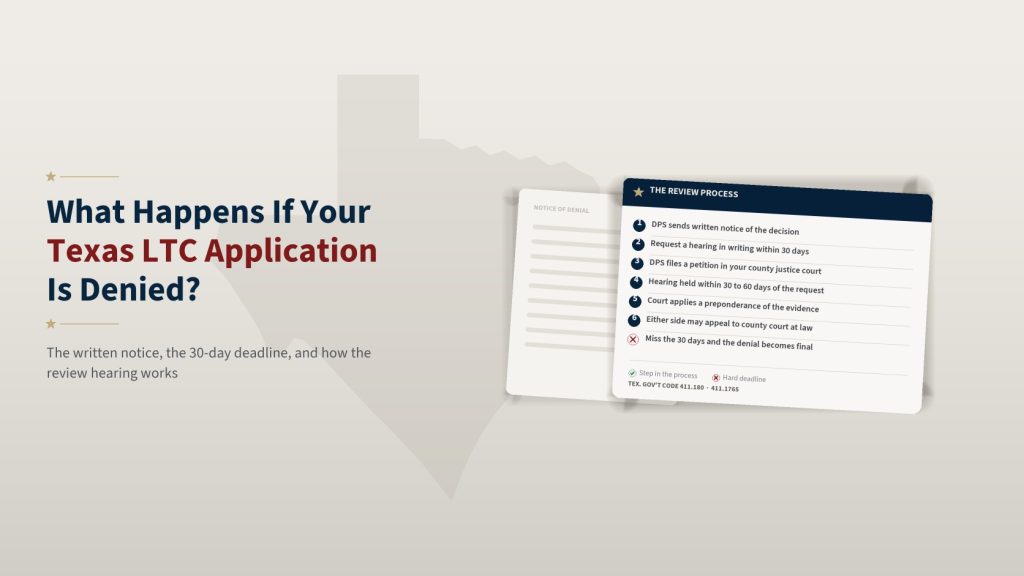
Here is the short version of the process laid out in Section 411.180.
- DPS must notify you in writing. The statute says DPS shall give written notice to each applicant of any denial, revocation, or suspension of a license.
- You have 30 days from receiving that notice to request a hearing. The request must be in writing, and it goes to DPS in Austin.
- DPS files a petition in justice court in the county where you live. A justice of the peace serves as the hearing officer.
- The hearing is held within 30 days of your request, and no later than 60 days after the request.
- The court decides whether the denial is supported by a preponderance of the evidence. If it is not, the court orders DPS to immediately issue or return the license.
- Either side may appeal to a county court at law within 30 days. That appeal is a trial de novo, without a jury.
- If you do not request a hearing within 30 days, the denial becomes final. A revocation or suspension takes effect.
Everything below unpacks those steps.
Step One: The Written Notice
The process starts with paper. DPS is required by statute to give written notice of a denial, a revocation, or a suspension. That notice is the trigger for everything that follows.
Two practical points matter here.
First, keep the notice. Do not throw the envelope away either. The date you received the notice is the date your clock starts, and being able to show when it arrived can matter.
Second, make sure DPS has your current mailing address. Notices go where the agency has been told to send them. If you moved during the application process and did not update your information, a notice can sit in an old mailbox while your deadline runs. If you are still waiting on a decision and want to know where things stand, the process for that is covered at checking your Texas LTC application status.
The 30-Day Clock Is the Whole Ballgame
If you remember one thing from this page, remember this. You have 30 days from receipt of the notice to request a hearing in writing.
Thirty days sounds like plenty. It is not. People spend the first week upset, the second week telling themselves they will handle it soon, and the third week trying to find someone to talk to. By the time they act, the window is closing.
The statute is clear about what happens if the request is not made in time. The denial becomes final. A revocation or suspension takes effect. There is no hearing to attend, because you did not ask for one.
That is not a technicality anyone can talk their way around later. Treat the date on that notice as the most important date on your calendar.
How the Hearing Request Works
The statute asks for two things: that the request be in writing, and that it go to DPS in Austin.
Put it in writing even if you talk to someone on the phone first. A phone call is not a written request. Keep a copy of what you send and keep proof of when you sent it.
This is also the point where most people benefit from talking to a Texas attorney. A hearing request starts a legal proceeding with a fixed deadline and a court date at the end of it. An attorney who handles these matters can tell you what your written request should say, what the county expects, and what you should bring. Nothing on this page can do that for you, because nothing on this page knows your record.
Where the Hearing Happens and Who Runs It
Once you make the request, DPS files a petition in a justice court in the county where you live. A justice of the peace serves as the hearing officer.
Two things about that are worth understanding.
It is local. You are not traveling to Austin to sit in an agency conference room. The proceeding happens in your own county.
And it is a court proceeding, run by a judge, on a record. That means it has procedure. It has rules about evidence and how things are presented. It is more formal than a phone appeal and less formal than a felony trial, and it deserves preparation.
The Timeline the Statute Sets
Section 411.180 puts real limits on how long this can take once you ask for it.
The hearing must be held within 30 days of the request for the hearing. It may not be held later than 60 days after the request.
That is worth appreciating. The statute does not let the matter drift indefinitely. Once you have asked, there is an outer boundary on when you will be heard.
It also means preparation time is short. A hearing that has to happen within 60 days of your request is not something to begin thinking about in week seven. If you are the type who likes to know the shape of the whole licensing process before you start, the general path is laid out at how to get a Texas LTC online, and the Texas LTC requirements page covers what the state asks of applicants in the first place.
What the Court Actually Decides
The court is not asked whether you seem like a good person or whether the agency was polite. It is asked a narrower question.
The standard in the statute is whether the denial, revocation, or suspension is supported by a preponderance of the evidence.
Preponderance of the evidence is the everyday civil standard. It means more likely than not. It is a lower bar than the beyond a reasonable doubt standard you have heard about in criminal cases. The question is simply which side the evidence tips toward.
If the court finds the denial, revocation, or suspension is not supported by a preponderance of the evidence, the statute says the court shall order DPS to immediately issue the license, or to return the license if it was revoked or suspended.
Notice the word immediately. When the court rules that way, the statute does not ask for another round of agency review.
If the Hearing Does Not Go Your Way
The justice court is not necessarily the last word. Either side may appeal the decision to a county court at law in the county where you live. That appeal has to be filed within 30 days of the justice court's decision.
The appeal is heard as a trial de novo, without a jury. Trial de novo means the county court hears the matter fresh rather than simply reviewing what the justice court did. Without a jury means a judge decides.
Note that either party may appeal. That includes DPS. Winning at the justice court level does not automatically end the matter, and that is another reason people in this position often work with counsel.
Fees, Expenses, and Attorney's Fees
The statute does not leave costs unaddressed. It points to Chapter 105 of the Texas Civil Practice and Remedies Code, which governs fees, expenses, and attorney's fees in these proceedings.
That is as far as this page will go on the subject, because how any of it applies depends entirely on the facts of a case and on how the proceeding turns out. It is a question for an attorney, not for a website. It is worth knowing the provision exists so you can ask about it.
A 2025 Protection Worth Knowing About
Texas added a protection that took effect on 1 September 2025. It applies to a specific kind of denial, and it is genuinely useful for the people it covers.
Section 411.1765 of the Texas Government Code, titled Notice of Certain Denials, was added by House Bill 1234 in the 89th Texas Legislature, Regular Session, 2025, Chapter 932.
Here is what it does. When DPS is considering denying an application based on an opinion from the medical advisory board about whether the applicant is capable of exercising sound judgment, DPS may not simply deny it. Before denying, DPS must first:
- Give the applicant written notice that specifically states the reason DPS is considering denying the application, and
- Give the applicant not less than 30 days to submit additional written materials.
DPS must then forward those materials to the full medical advisory board, obtain written reports from board members reassessing the applicant, and only then make its decision.
In plain terms, this section gives people a chance to respond with information before a decision is made, instead of only after. It applies to original applications and to renewal applications alike.
If that describes the ground your own situation sits on, the eligibility standard behind it is explained at Texas LTC and mental health history.
Denial, Revocation, and Suspension Follow the Same Path
Section 411.180 does not treat these three separately when it comes to your right to be heard. The written notice requirement, the 30-day request window, the justice court hearing, the preponderance standard, and the appeal all apply across the board.
The practical difference is what is at stake. A denial means a license you do not yet hold. A revocation or suspension affects a license you already carry, and the statute says that if no request is made in time, the revocation or suspension takes effect.
If you already hold a license and are simply trying to keep it current, that is a different and much simpler process, covered at Texas LTC renewal.
Understanding the Reason Behind the Decision
This page is about the process, not the reasons. But the reason matters, because it shapes what a hearing would be about.
Texas does not leave eligibility to opinion. The disqualifying conditions are written into the statute, and you can read them. The full list, in plain language, is at what disqualifies you from a Texas LTC, and the broader standard is covered at Texas LTC eligibility.
Reading those pages will not tell you why your own application was decided the way it was. Only the notice from DPS and, if it comes to that, the hearing itself will do that. But it will help you understand the framework the decision sits inside, and it will help you ask better questions of the attorney you talk to.
Why This Is a Conversation for a Texas Attorney
We will say it plainly, because it is the responsible thing to say.
If you have received a notice of denial, revocation, or suspension, talk to a Texas attorney who handles License to Carry matters, and do it quickly. This is not a form to fill out. It is a legal proceeding, in a court, against a state agency, with a deadline that ends your options if you miss it.
Nothing here is a prediction about your case. We cannot tell you how a hearing would go, and no honest source can. What we can tell you is that the right to ask for one exists, that it has a short fuse, and that people who act early have more room to work with than people who wait.
If You Have Not Applied Yet
Most people reading this have already received a notice. Some have not. They are researching before they apply, because something in their past worries them.
If that is you, the useful move is to understand the rules before you spend the money. Texas wrote the eligibility standards down. Read them. Ask a Texas attorney about anything specific in your history that concerns you, before you file rather than after.
And if your concern is more about timing than eligibility, the realistic picture of how long the Texas LTC process takes will give you a better sense of what to expect from start to finish.
A denial is not a verdict on your character. It is an administrative decision, made under a written standard, and the Legislature built a way to have it reviewed. Knowing that ahead of time is worth something, whether or not you ever need it.
Frequently Asked Questions
How long do you have to appeal a Texas LTC denial?
Thirty days from receipt of the written notice. Under Texas Government Code Section 411.180 the request for a hearing must be made in writing to DPS in Austin. If no request is made in that window, the denial becomes final.
Where is a Texas LTC denial hearing held?
DPS files a petition in a justice court in the applicant’s county of residence, and a justice of the peace serves as the administrative hearing officer. The hearing must be held within 30 days of the request and no later than 60 days after it.
What does the court decide at an LTC hearing?
The court decides whether the denial, revocation or suspension is supported by a preponderance of the evidence. If it is not, the court orders DPS to immediately issue or return the license.
Can a Texas LTC denial decision be appealed further?
Yes. Either side may appeal to a county court at law within 30 days. That appeal is a trial de novo, heard without a jury.
Does DPS have to explain why it is considering a denial?
In one category of case, yes. Section 411.1765, added by House Bill 1234 and effective 1 September 2025, requires DPS to give written notice specifically stating the reason, and at least 30 days to submit additional written materials, before denying an application based on a medical advisory board opinion about sound judgment.
Disclaimer: The information provided in this article is for general educational and informational purposes only and should not be considered legal advice. First Shot Training is not a law firm and does not provide legal advice. While we make every reasonable effort to ensure the information we publish is accurate and up to date at the time of publication, laws, regulations, licensing requirements, reciprocity agreements, and government policies may change without notice. You are responsible for verifying current information with official government sources before relying on any information contained in this article. If you have questions regarding how the law applies to your specific circumstances, consult a qualified attorney licensed in your jurisdiction.